

GST Reconciliation Using AI: A CFO's Guide to Faster ITC and Fewer Notices
By BiPivot Team · 25 August 2026
Every mid-sized Indian company that has been through a GST audit knows the drill: an officer asks why GSTR-3B for October 2024 doesn't tie out with GSTR-2B, and someone in the finance team spends three days pulling invoice-level data out of Tally or SAP to explain a ₹4.2 lakh gap that turned out to be a vendor's late upload. Multiply that by twelve months, dozens of vendors, and thousands of line items, and you understand why GST reconciliation quietly consumes more finance bandwidth than almost any other compliance task.
The stakes have also changed. The taxpayer base has grown from 66.5 lakh in 2017 to 1.65 crore, and gross GST revenue has climbed from roughly ₹7.4 lakh crore in 2017-18 to ₹22.27 lakh crore in 2025-26 (source). GSTN itself now uses AI to police that base. This article is about why manual reconciliation is no longer good enough to keep up, and what a practical AI-driven reconciliation process looks like for a company doing ₹150-800 crore in annual revenue.
What is GST reconciliation, and why is it so error-prone?
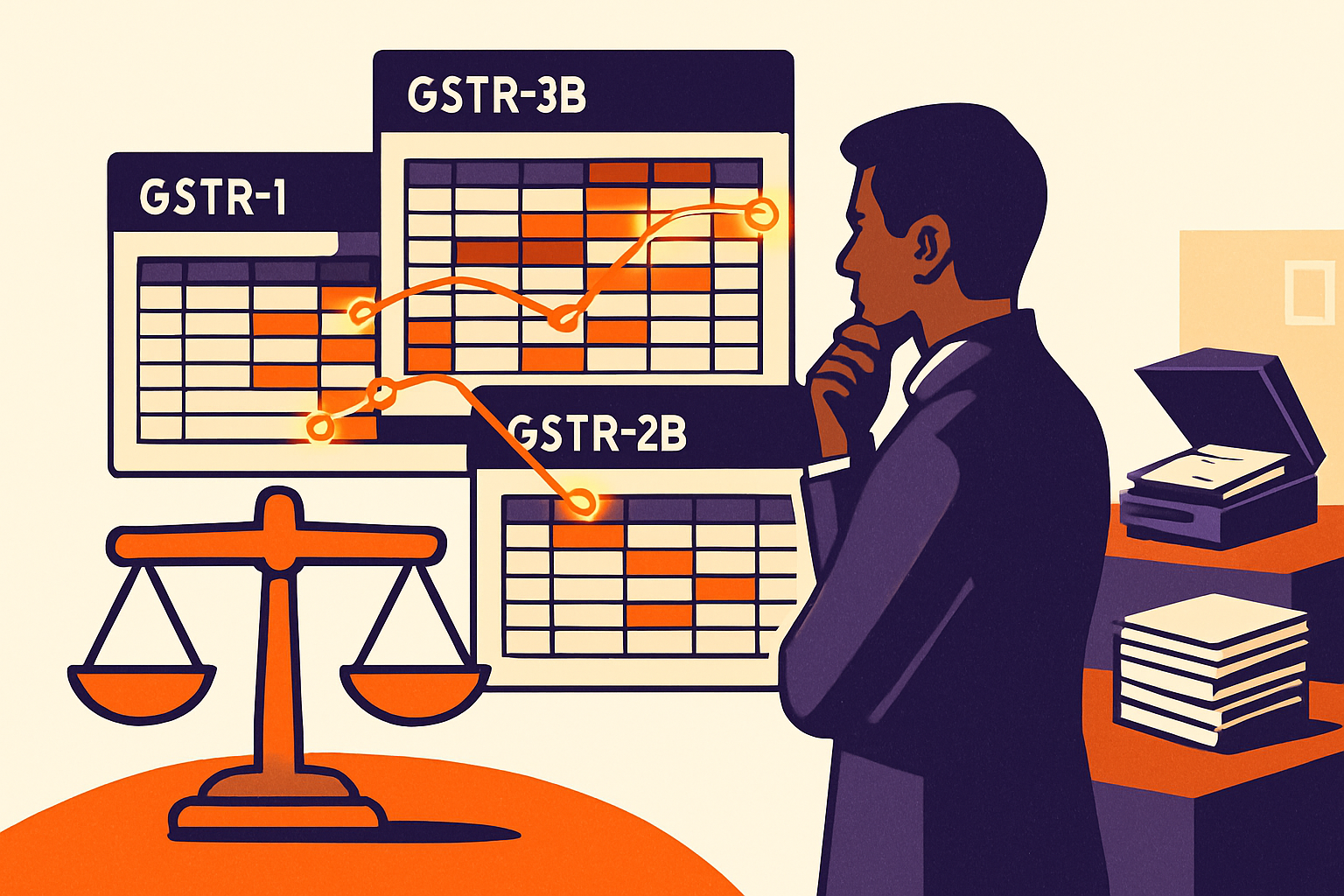
GST reconciliation is the process of matching a company's internal purchase and sales registers against three government-side records: GSTR-1 (outward supplies), GSTR-3B (summary return and tax payment), and GSTR-2B (auto-drafted ITC statement from vendors' filings) (source). The objective is threefold: maximize eligible ITC claims, catch discrepancies before the department does, and avoid penalties for incorrect or delayed filings (source).
In practice, this means reconciling three separate data flows every month:
- Sales register vs GSTR-1 — did every invoice you raised actually get reported correctly?
- GSTR-1 vs GSTR-3B — does your summary return match what you declared invoice-wise?
- Purchase register vs GSTR-2B — is every vendor invoice you're claiming ITC on actually reflected in the government system?
Common failure points, per NRICA's review of GST filing errors, include mismatched GSTINs, wrong invoice numbers or dates, GSTR-1/GSTR-3B discrepancies, and outright failure to reconcile GSTR-2B against purchase records (source). A finance team manually reconciling 3,000-5,000 invoices a month in Excel will typically miss 3-5% of mismatches simply due to volume and fatigue — and those misses become blocked ITC or interest liabilities six months later.
Consider a real pattern we see often: a Pune-based auto components manufacturer with ₹320 crore turnover claims ITC of ₹38 lakh in a month based on its purchase register. GSTR-2B, however, reflects only ₹34.6 lakh because two vendors filed late and one vendor reported the wrong GSTIN. If this ₹3.4 lakh gap isn't caught and reversed proactively, it surfaces in a scrutiny notice eight months later, now carrying interest at 18% per annum and a demand for explanation the finance team can barely reconstruct from memory.
Why has GST reconciliation evolved into a strategic risk for businesses?
Three regulatory shifts have raised the cost of getting this wrong.
First, e-invoicing has changed the baseline. E-invoicing is now mandatory for businesses with turnover above ₹10 crore, which covers most of the mid-market. It reduces data entry errors and speeds up return filing by feeding real-time invoice data into the GST system (source). But it also means the government has your invoice data before you file — there is far less room to "explain away" a mismatch as a data entry issue.
Second, the government's own AI has gotten sharper. Systems like NETRA, BIFA, and ADVAIT are actively used by tax authorities for anomaly detection and risk scoring (source). Between April and December 2023 alone, AI-assisted enforcement helped detect 14,597 tax evasion cases and uncovered ₹18,000 crore in fake ITC, leading to 98 arrests (source). Your reconciliation gaps are being scored by an algorithm before a human officer ever looks at your file.
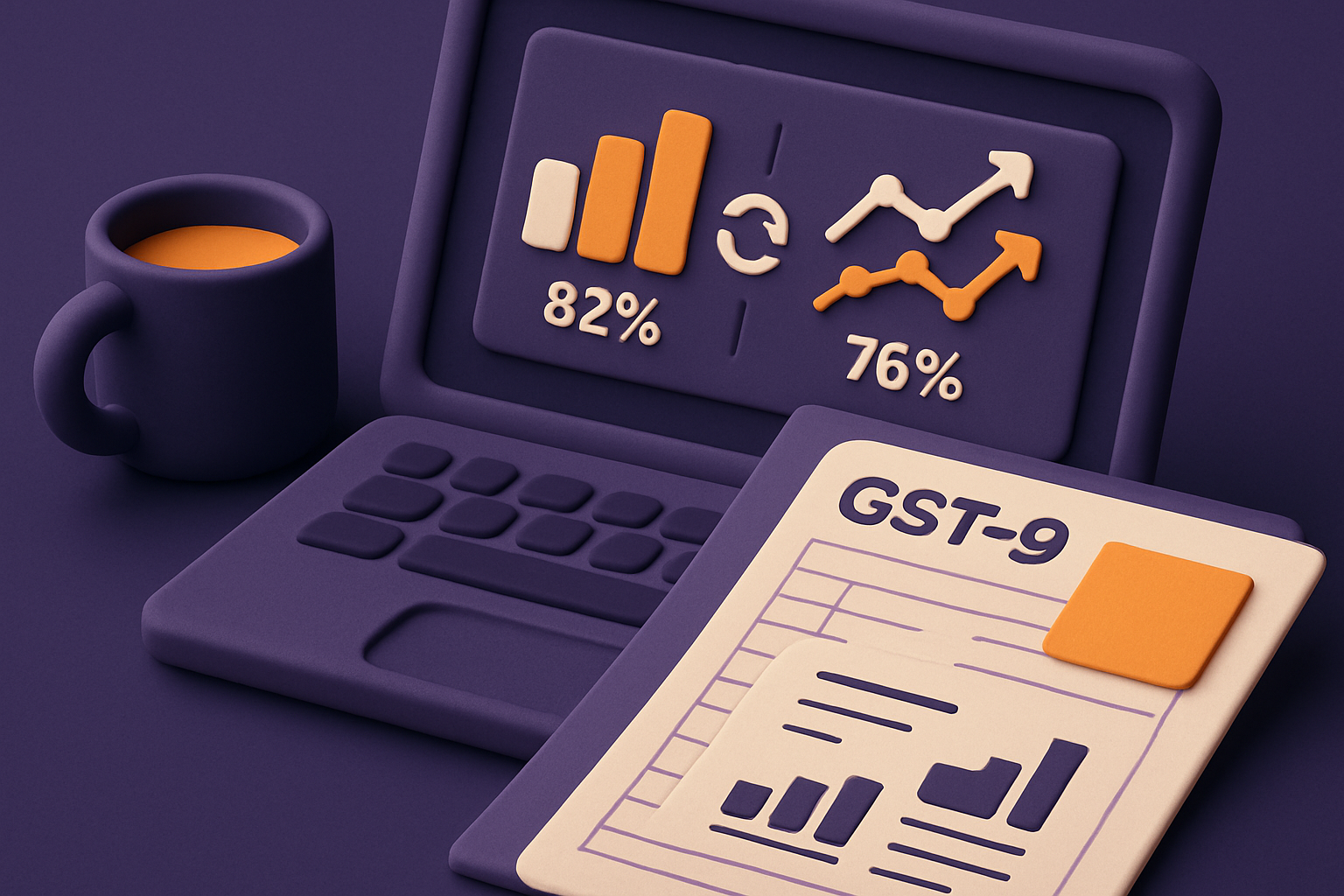
Third, the compliance obligation itself is codified, not optional. Section 35 of the CGST Act requires every registered person to maintain proper books and records, and Section 44 requires an annual return (GSTR-9) with a self-certified reconciliation statement (source). This isn't a nice-to-have process — it's a statutory filing obligation with your name on it.
Layer on the deadline pressure: ITC for a financial year must be claimed by November 30 of the following year, or the date of filing GSTR-9, whichever is earlier (source). And if you've claimed ITC on an invoice but haven't paid the supplier within 180 days, you must reverse that credit along with 18% penal interest (source). Miss either of these and the cash flow hit is real, not theoretical.
It's telling that in Deloitte's June 2025 "GST@9" survey, 89% of respondents said they wanted AI-led data processing and reconciliation built directly into the proposed GSTN 2.0 (source) — practitioners themselves recognize that manual matching has run out of road.
How does AI fundamentally change the mechanics of GST reconciliation?
Strip away the marketing language, and AI-powered GST reconciliation does four concrete things a spreadsheet-driven process cannot:
1. Automated data capture via OCR and machine learning. Instead of a junior accountant keying in invoice numbers, dates, and GSTINs from PDF invoices or vendor emails, OCR engines extract this data automatically and feed it into the reconciliation engine — cutting a major source of the GSTIN/invoice-number errors flagged as the most common cause of mismatches (source).
2. Real-time, invoice-level matching across GSTR-1, GSTR-3B, and GSTR-2B. Rather than a month-end scramble, matching happens continuously as data comes in, with fuzzy-matching logic that can flag a vendor invoice as "likely match, date differs by 2 days" instead of a flat mismatch that a human then has to investigate from scratch.
3. Predictive flagging of audit-risk patterns. AI models trained on historical mismatch patterns can flag unusual ITC claims — say, a sudden spike in ITC from a newly onboarded vendor, or claims against a supplier whose own filing compliance score has dropped — before the return is filed, not after a notice arrives (source).
4. Continuous learning from resolution patterns. Every time your team manually resolves a mismatch (e.g., "this vendor always files GSTR-1 five days late, but always correctly"), a well-configured system learns that pattern and stops flagging it as high-risk next month — reducing the noise that causes reconciliation fatigue.
The measurable result is significant. A documented case study of a mid-sized Indian retail business found a 50% reduction in GST compliance errors and consistently timely filing after adopting AI-powered tax software (source). For a company reconciling ₹40-50 crore of monthly purchase invoices, even a 2% reduction in missed ITC translates to ₹80 lakh-₹1 crore a year retained in working capital rather than written off or delayed.
Worked example: A Bengaluru-based IT hardware distributor with ₹450 crore turnover was manually reconciling GSTR-2B against roughly 6,000 purchase invoices monthly, taking two people nearly nine working days each cycle. After deploying an AI-based matching layer connected to their Tally exports, invoice-level matching completed in under six hours, with only the genuine exceptions (roughly 4% of invoices) routed for human review. The finance team redirected that freed capacity toward vendor follow-ups on the 180-day payment rule — directly reducing the ITC reversals they'd been absorbing every quarter.
Does AI-powered GST reconciliation add to technological complexity?
This is the question every CFO should ask before signing a purchase order, and it's a fair one. Indian mid-market companies have embraced AI faster than almost anywhere else — 36% of Indian mid-market organizations have already embedded AI across multiple core functions, more than double the global average of 15% (source). But the same research found that 27% of the average mid-market AI budget in India — an estimated ₹33,000 crore annually across the segment — is lost to "complexity overhead": tools that don't talk to each other, duplicate dashboards, and IT teams stretched thin managing integrations (source).
The lesson for GST reconciliation specifically: don't buy a standalone AI reconciliation tool that sits outside your ERP and requires yet another login, yet another data export, and yet another reconciliation of the reconciliation tool itself. The right approach connects directly to your existing books — Tally, SAP, or Zoho Books — pulls GSTR-1/2B/3B data via GSTN APIs, and surfaces exceptions inside the finance team's existing workflow rather than a parallel system. If your team already has a modern reporting layer built on Power BI or Microsoft Fabric, GST reconciliation should be a module within that architecture, not a competing one. Our guide on the modern finance tech stack for mid-sized Indian companies covers how to evaluate this fit before you buy.
How does AI-driven GST reconciliation integrate with a company's broader control environment?
Treating GST reconciliation as an isolated monthly task is itself a risk. The same mismatches that trigger GST scrutiny — a vendor invoice booked twice, a payment made without matching TDS deduction, a bank entry that doesn't tie to either — tend to cluster together, because they share a root cause: weak controls at the point of data entry, not at the point of filing.
A genuinely useful AI reconciliation layer doesn't stop at GST. It should also reconcile TDS deductions against Form 26AS and vendor ledgers, and match bank statement entries against both. We've written in detail about why TDS automation can't wait for the new Income Tax Act, in our piece on TDS compliance automation for mid-sized Indian CFOs — the overlap with GST reconciliation is not coincidental. A vendor invoice that's wrong for GST purposes is very often wrong for TDS purposes too, and catching it once, at the source, prevents the same error cascading into two separate compliance failures.
This is also where internal financial controls intersect with tax technology. If your purchase-to-pay process doesn't enforce three-way matching (PO, GRN, invoice) before an invoice is booked, no amount of downstream AI reconciliation will fully compensate. Our framework on internal financial controls for mid-sized Indian companies sets out what controls actually need to exist upstream so that GST reconciliation becomes confirmatory rather than the sole line of defense.
What is the practical sequence for a CFO to implement AI GST reconciliation?
Rolling out AI-assisted GST reconciliation is a finance-led initiative, not an IT procurement exercise, even though IT will need to be involved for API access and data security sign-off. Here's a practical sequence we've used with clients:
Step 1 — Baseline the current mismatch rate (Weeks 1-2). Before any tool selection, pull the last six months of GSTR-2B vs purchase register data and quantify: what percentage of invoices matched automatically, what percentage required manual intervention, and what was the average resolution time. This baseline is what you'll measure ROI against later, and it's often more revealing than expected — most companies discover their "manual reconciliation" was actually only catching 70-80% of true mismatches.
Step 2 — Fix the upstream data quality issue first (Weeks 2-4). If your vendor master doesn't enforce GSTIN validation at entry, or your AP team doesn't capture invoice dates consistently, no AI tool will fix that — it will just flag the same errors faster. This is a one-time data hygiene exercise: validate GSTINs against the GST portal for your top 200 vendors by ITC value, since these typically represent 70-80% of your claimed credit.
Step 3 — Select and pilot on one GST registration (Weeks 4-8). If you operate across multiple states, pilot the AI reconciliation on your highest-transaction-volume GSTIN first. Set a clear success metric: reduce manual review time by 50% and reduce unexplained ITC gaps to under 1% of claimed credit within two filing cycles.
Step 4 — Extend to full multi-GSTIN rollout with exception-based review (Months 3-4). Once the pilot proves out, extend across all registrations, but keep human review focused only on genuine exceptions the AI flags — not a full re-check of everything the system has already matched. This is where the complexity-overhead trap bites companies: if your finance team is still manually re-verifying AI-matched invoices "just to be safe," you haven't actually reduced workload, you've added a layer.
Step 5 — Build the GSTR-9 reconciliation statement as a byproduct, not a year-end scramble (ongoing). Since Section 44 requires a self-certified reconciliation statement with your annual return, a system that reconciles continuously through the year should be able to generate most of the GSTR-9 reconciliation as a standing report, rather than requiring a fresh twelve-month exercise every September.
Worked example on ROI: a Chennai-based textile exporter with ₹280 crore turnover spent roughly ₹18 lakh annually on two full-time reconciliation staff plus a part-time consultant for GSTR-9 preparation. After implementing an AI-assisted reconciliation workflow integrated with their SAP instance, one FTE was redeployed to vendor risk monitoring, GSTR-9 preparation time dropped from six weeks to ten days, and the company recovered ₹22 lakh in ITC that had previously gone unclaimed due to missed GSTR-2B matches in the prior two years. The tooling cost was under ₹6 lakh a year — a clear net positive within the first cycle.
What is the CFO's essential role in overseeing AI-enabled GST reconciliation?
This is where mid-sized companies often get the sequencing wrong. GST reconciliation has historically been treated as a tax or compliance team task, reviewed by the CFO only when a notice arrives. That model doesn't work when the government's own AI is scoring your filings continuously and your ITC exposure moves in real time with every vendor's filing behavior.
The CFO's role in an AI-enabled reconciliation process should be:
- Set the risk appetite. Decide what counts as an "auto-approve" mismatch (e.g., a one-day date difference on a recurring vendor) versus what must always be escalated (e.g., any GSTIN mismatch above ₹1 lakh in value).
- Own the monthly exception dashboard, not the line-item matching. A CFO reviewing 15-20 flagged exceptions a month with dollar values attached is a far better use of senior time than a tax team reconciling 5,000 rows manually.
- Tie reconciliation health to cash flow forecasting. Blocked or delayed ITC is working capital sitting idle. If your treasury forecast doesn't reflect the ₹1-2 crore of ITC currently stuck in mismatch resolution, your cash position is being systematically understated.
- Ensure audit trail integrity, since this is what tax officers and auditors will actually inspect — not the elegance of your dashboard, but whether every exception has a documented resolution.
For a broader view of how CFOs should be structuring AI oversight across finance — not just for GST but as a governance discipline — see our playbook on governance in the age of AI for mid-sized Indian CFOs. GST reconciliation is a good first proving ground for that governance model precisely because the stakes (penalties, blocked cash, audit exposure) are concrete and immediate, unlike some AI use cases where ROI is harder to pin down.
What are the realistic timelines and limitations of AI in GST reconciliation?
Be honest with your board about what AI reconciliation does and doesn't solve. It will not fix a fundamentally broken vendor management process, and it will not eliminate the need for a qualified tax professional to interpret genuinely ambiguous cases — a change in place of supply rules, or a classification dispute, still needs human judgment. What it reliably does is eliminate the mechanical drudgery of matching thousands of invoice line items and surface the 3-5% of cases that actually need expert attention.
A realistic timeline for a mid-sized company (₹200-600 crore turnover, single or a few GSTINs) is 8-12 weeks from baseline to steady-state exception-based review, assuming reasonably clean vendor master data to start. Companies with messy vendor masters or multiple ERPs across business units should budget an additional 4-6 weeks purely for data hygiene before expecting the AI layer to perform well — this is consistently the step teams try to skip and consistently the step that determines whether the rollout succeeds.
Given that consulting firms like EY India are now building dedicated AI Tax Hub offerings specifically for compliance and litigation support in the Indian regulatory context (source), the direction of travel is clear: reconciliation is moving from a monthly chore to a continuous, machine-assisted control function. Mid-sized companies that build this capability now, integrated cleanly into their existing finance stack, will spend FY27 explaining variances proactively to auditors instead of reactively to tax notices.
How BiPivot helps
BiPivot works with finance teams to design GST reconciliation workflows that plug into your existing Tally or SAP environment rather than adding another disconnected tool, so exception review — not re-verification of AI output — becomes the team's real job. If you're evaluating where AI reconciliation fits into your broader finance architecture, explore our consulting approach or browse bipivot.com for how we structure these engagements.