

Why Excel Alone Is No Longer Enough for Mid-Sized Indian Companies
By BiPivot Team · 25 July 2026
Walk into the finance department of almost any mid-sized Indian company — a Rs 150-300 crore manufacturer in Pune, a multi-branch NBFC in Ahmedabad, a D2C brand scaling out of Bengaluru — and you'll find the same file open on someone's screen: a master Excel workbook, twelve tabs deep, with a name like "MIS_Final_v14_USE_THIS_ONE.xlsx." It has survived three CFOs, two ERP evaluations, and at least one GST audit. Everyone knows it's fragile. Nobody has replaced it.
That's the paradox this article is about. As the backbone of recurring, compliance-critical, multi-entity financial operations, Excel has quietly become one of the biggest sources of risk in Indian finance functions. The reason isn't that Excel got worse. It's that the job got bigger—more transactions, more entities, more real-time regulatory reporting—while Excel's core design remained unchanged.
Why is Excel struggling to keep up with modern finance operations in mid-sized Indian companies?
Excel was designed as a personal calculation tool, not a multi-user, high-volume, compliance-grade system of record. That mismatch is the root of almost every problem finance heads describe when you ask them what keeps them up at night before a board meeting or a GST deadline.
Consider what a typical month-end close looks like at a mid-sized Indian manufacturing company with three plants and a head office. Plant accountants export data from Tally or SAP B1 into local Excel files. These get emailed to the corporate finance team, who paste values into a consolidation workbook, apply manual adjustment entries, and cross-check inter-unit transfers by eye. A single formula error in one plant's file — a dragged cell reference that pulled the wrong month's depreciation — can silently misstate consolidated EBITDA by lakhs before anyone notices, sometimes not until the statutory auditor flags it three months later.
This isn't a hypothetical edge case. Research shows that over 90% of spreadsheets contain errors, many of which go completely unnoticed in financial reporting until they cause real damage. Excel wasn't built for high-volume, real-time, compliance-driven financial workflows, and that gap only widens as transaction volume grows.
What are the real costs of Excel errors for mid-sized Indian companies?
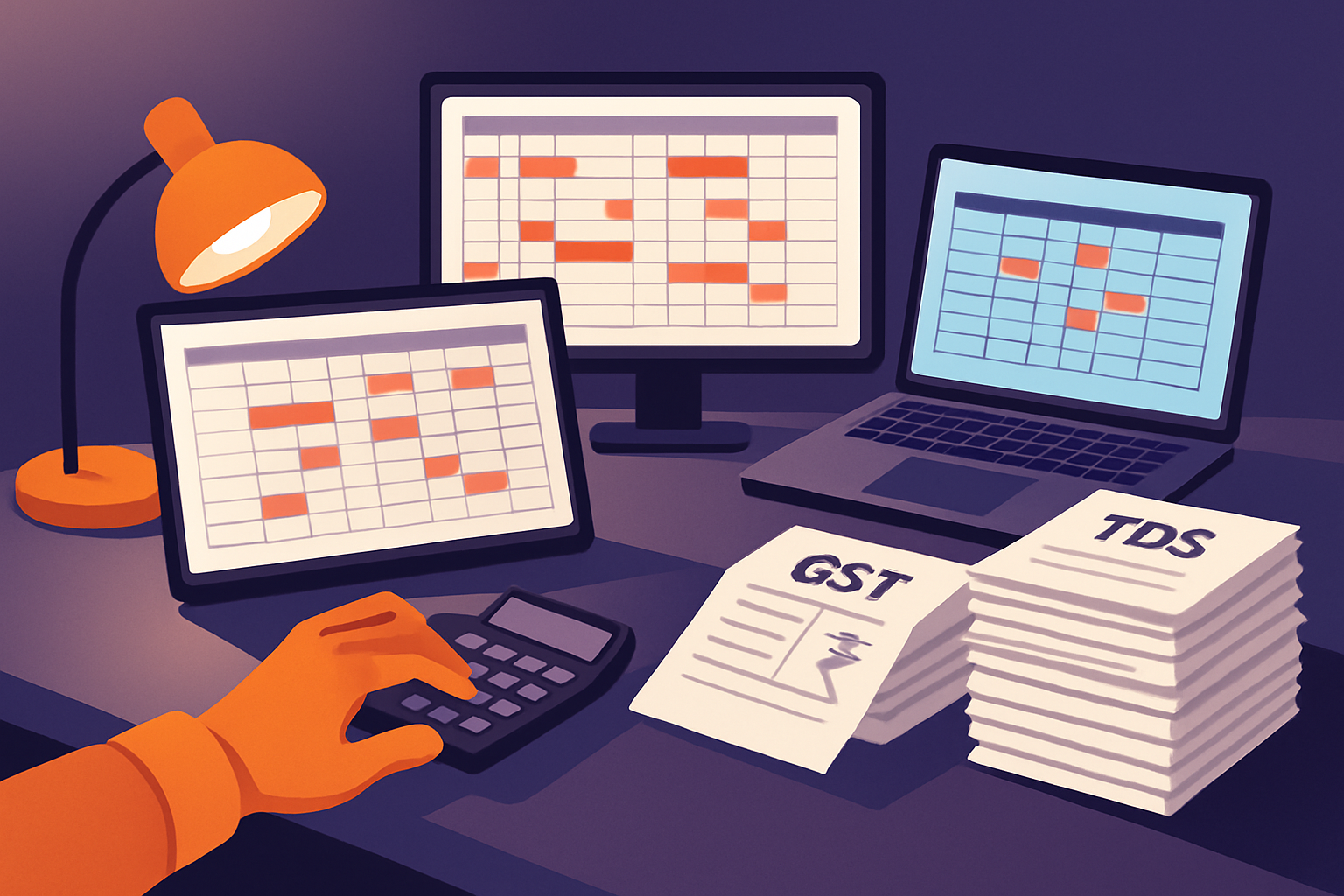
CFOs often underestimate this because Excel errors rarely announce themselves. They surface as a GST mismatch notice, an inflated TDS liability, or a lender questioning why quarterly numbers don't tie back to the prior filing. Let's put real numbers on it.
Worked example — GST input credit mismatch. A Rs 200 crore turnover trading company reconciles GSTR-2B against purchase register manually in Excel every month, matching roughly 4,000 invoice lines by VLOOKUP. A finance executive mis-keys one supplier's GSTIN digit while copy-pasting from a scanned invoice PDF. The result: Rs 8.4 lakh of input tax credit gets claimed against a supplier who never filed their GSTR-1. Six months later, the mismatch surfaces in the annual reconciliation (GSTR-9C), triggering a demand notice with interest at 18% per annum plus potential penalty under Section 122. What started as one wrong keystroke in a spreadsheet becomes a Rs 10+ lakh cash outflow and weeks of departmental correspondence to resolve.
Worked example — TDS short-deduction. A services company with 40 vendor contracts tracks TDS applicability (194C vs 194J vs 194Q) in a shared Excel tracker updated by whoever processes that week's vendor payments. A new joiner misclassifies a professional services vendor under 194C (2%) instead of 194J (10%), because the tracker's dropdown wasn't updated after the last rate change. Across a quarter, that's Rs 6 lakh of TDS short-deducted on Rs 75 lakh of payments — discovered only at the time of filing Form 26Q, by when interest under Section 201(1A) has already started accruing at 1.5% per month.
These aren't dramatic hacking incidents or fraud cases. They're routine, boring, entirely preventable errors that Excel's design makes almost inevitable — because Excel relies on human discipline for accuracy, with no system-level checks against duplicate entries, broken formulas, or incorrect classification.
How does India's regulatory complexity highlight the limitations of spreadsheets?
Generic Excel criticism talks about "errors" in the abstract. For Indian finance teams, the sharper issue is that GST, TDS, and MCA compliance are not static, once-a-year exercises — they are continuous, interlocking, frequently amended obligations that spreadsheets simply cannot track reliably at scale.
Think about what a finance controller at a mid-sized company juggles in a single month:
- Monthly GSTR-1 and GSTR-3B filings, with e-invoicing thresholds and reconciliation against GSTR-2B
- TDS deduction across multiple sections (194C, 194J, 194Q, 194R) with rate and threshold changes that get notified mid-year
- MCA e-filing requirements — AOC-4, MGT-7, DPT-3 — each with entity-specific triggers and penalty structures for delay
- Multi-state GST registrations if the company sells across state lines, each requiring separate reconciliation
Navigating this complex, evolving regulatory environment manually is a genuine strain even for well-staffed teams, and it is precisely the kind of workflow where Excel's lack of an audit trail becomes dangerous — not just inefficient. When a GST officer or MCA scrutiny asks "who made this adjustment entry, and when, and why," an Excel file with no version history and no user-level log leaves finance teams reconstructing events from memory and email threads. Excel lacks essential audit trail, version control, and enterprise-grade security features that compliance-heavy finance work now requires as a baseline, not a luxury.
Contrast this with how a mid-sized company's internal audit function should be evaluating control gaps in the first place — a subject we cover in detail in AI for Internal Audit: Practical Use Cases for Mid-Sized Indian Companies. That article focuses on how AI-assisted audit sampling and anomaly detection change the audit function. This article is about the layer beneath that: the transactional and reporting infrastructure itself, and why relying on Excel as the system of record makes the audit function's job harder in the first place, no matter how sophisticated your audit tooling becomes.
Is a lack of collaboration a significant hidden cost when using Excel?
Ask any finance head how many versions of "the" MIS file exist across the organization at any given time, and watch them wince. Multiple people editing local copies, emailing updates, and manually reconciling "final_final_v2" against "final_final_v3" is not a minor inconvenience — it is a structural inability to collaborate that directly causes data discrepancies finance leaders then have to explain to the board.
This limitation compounds with company growth. For mid-sized Indian companies that are multi-entity, multi-location, or multi-currency structures—like a holding company with two subsidiaries, a manufacturing unit and a trading arm, or a business with both domestic and export operations under different GST registrations—multi-entity consolidation in Excel means manually mapping chart-of-accounts differences, currency translation, and inter-company eliminations by hand every single month. Modern finance functions demand real-time insight and scalability that Excel structurally cannot deliver once you cross that complexity threshold.
The time cost is significant and recurring. Finance teams routinely report that manual reporting processes consume excessive hours in data preparation alone, with the byproduct being delayed, stale numbers by the time they reach decision-makers — precisely when speed matters most, whether it's negotiating a working capital facility or responding to a board query on margin compression.
What is the AI adoption gap costing mid-sized Indian firms competitively?
Here's the part most CFOs at mid-sized companies underestimate: this isn't only an internal efficiency problem anymore — it's a competitive one. While an estimated 70-80% of larger Indian corporates are actively embracing AI and digital transformation in accounting and finance, a large share of small and mid-sized firms remain stuck in Excel-first, manual-reconciliation mode. That gap is widening, not narrowing.
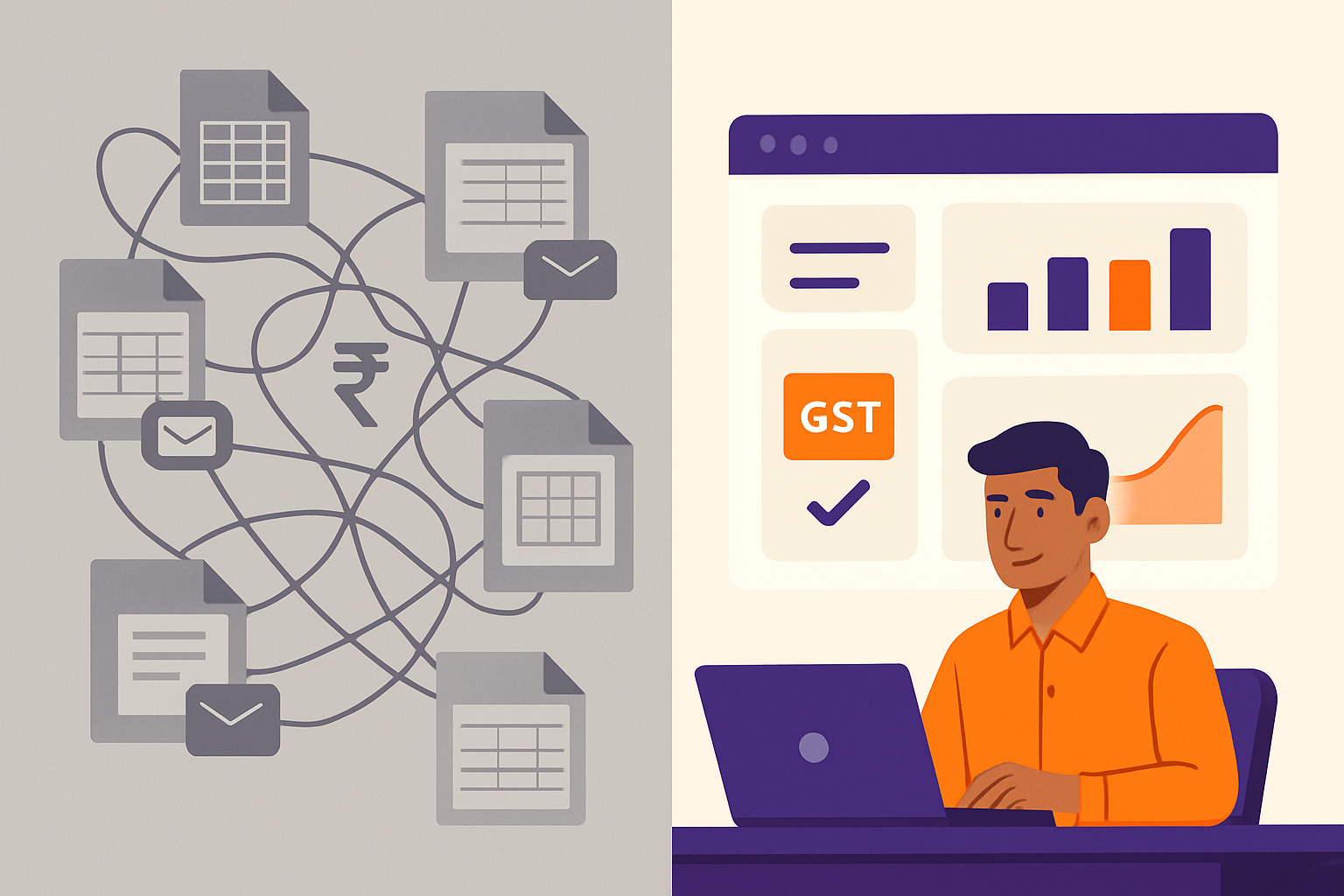
The productivity difference is not marginal. Indian businesses that have automated routine tasks like GST filing report time savings of up to 80% on those processes. Separately, 65% of Indian financial firms have adopted AI for data management and reporting in the past year, and those using AI-driven tools report a 40% reduction in financial reporting errors. Put simply: while your team spends three days every month manually reconciling GSTR-2B against your purchase register, a competitor running automated matching completes the same task in under half a day, with fewer errors and a full audit trail to show for it — freeing that time for margin analysis, vendor negotiation, or working capital planning instead.
For a mid-sized company, this compounds. A larger enterprise can absorb inefficiency with sheer headcount. A 200-person mid-sized firm cannot — every hour a finance executive spends manually re-keying data from Tally into Excel and back is an hour not spent on the analysis that actually protects margin or catches a cash flow problem three weeks before it becomes a crisis.
How is the CFO's job changing, and how does Excel hinder this transition?
There's a broader shift underway in what CFOs at Indian companies are actually expected to do. The traditional "custodian" CFO — someone whose primary job was closing books accurately and filing returns on time — is being replaced by a "strategic catalyst" CFO, someone expected to use financial data to actively shape business strategy: pricing decisions, capital allocation, working capital optimization, M&A evaluation.
That shift is structurally impossible to execute if your finance team's bandwidth is consumed by manual spreadsheet maintenance. You cannot ask a controller to build a rolling 13-week cash flow forecast with scenario modeling for input cost inflation if that same person is spending 60% of their week manually reconciling vendor ledgers in Excel because last month's automated bank feed broke a formula.
This is where AI's role in finance stops being about basic automation and becomes about strategic foresight. The distinction matters: automating a GST reconciliation is useful, but it's still backward-looking — it tells you what happened last month. AI applied to receivables data, for instance, can flag which customers are showing early signs of payment delay risk before they actually default, giving a mid-sized company weeks of lead time to tighten credit terms or renegotiate — the kind of predictive, forward-looking insight that a CFO acting as strategic catalyst needs, and that no amount of spreadsheet discipline can produce, because Excel has no memory of pattern, only of the last entry someone typed in.
72% of finance departments report that workflow automation directly improves accuracy and compliance — not as a side benefit, but as a primary outcome. For a mid-sized company navigating GST, TDS, and MCA simultaneously, that improvement in accuracy is often the difference between a clean statutory audit and a qualified one.

Should mid-sized Indian companies rush AI adoption, or is there a governance trap to avoid?
Here's where most articles on this topic stop — "adopt AI, get efficient." But there's a genuine trap mid-sized Indian companies need to be aware of before they act.
85% of Indian finance leaders currently feel pressure to prove ROI on AI investments quickly. The problem is what that pressure produces: 71% of these leaders prioritize deployment speed over governance, and a mere 8% prioritize governance as their top concern when rolling out AI tools. That's a dangerous ratio for a function whose entire value proposition rests on accuracy, accountability, and auditability.
What does poor governance actually look like in practice? A finance team adopts an AI-powered invoice processing tool to speed up accounts payable, rolls it out across three plants within a month to show quick wins, but never defines who reviews and approves AI-flagged exceptions, never sets a threshold for which transactions require human sign-off, and never documents the model's decision logic for the statutory auditor. Six months later, when the auditor asks "explain how this Rs 40 lakh vendor payment was approved without a manual PO match," there's no clear answer — because the control framework was never built before the tool went live.
The practical fix for a mid-sized company is not to slow down AI adoption — the productivity gap is too real and too costly to ignore — but to build three things into any deployment from day one:
- A clear approval hierarchy for AI-flagged exceptions, with named owners and defined escalation thresholds (e.g., anything above Rs 5 lakh requires CFO sign-off regardless of what the AI recommends).
- A documented audit trail for every AI-assisted decision — not just the output, but the input data and logic path, so a statutory or GST auditor can reconstruct the reasoning.
- A quarterly governance review, not a one-time implementation checklist — regulatory and business context changes, and the control framework needs to keep pace with it.
Get this sequencing right, and you capture the efficiency gains without inheriting a new category of audit risk in place of the old spreadsheet risk you were trying to eliminate.
What practical steps should a mid-sized Indian CFO take this quarter?
If you're a finance head reading this and recognizing your own MIS process in the examples above, the fix isn't "replace Excel with an ERP overnight" — that's expensive, disruptive, and often unnecessary as a first step. A more realistic sequence for a mid-sized company looks like this:
-
Audit your current spreadsheet risk exposure. Identify the three or four Excel workbooks that carry the highest compliance or reporting risk — typically GST reconciliation, TDS tracking, and multi-entity consolidation. These are your priority targets, not your entire finance stack.
-
Automate the highest-error, highest-frequency processes first. GST 2B reconciliation and TDS section-mapping are strong starting points precisely because they're high-volume, rule-based, and currently manual — exactly where automation delivers the fastest, most measurable ROI, in line with the 80% time-savings figure Indian businesses report on automated GST processes.
-
Build governance alongside automation, not after it. Define approval thresholds and audit trail requirements before go-live, not as a retrofit once your statutory auditor asks the hard question.
-
Redirect freed-up finance hours toward analysis, not more transaction processing. The point of automating reconciliation isn't just accuracy — it's giving your controller and CFO the bandwidth to do the forward-looking, strategic-catalyst work that actually moves the business.
None of this requires a Rs 2 crore ERP transformation project on day one. It requires an honest inventory of where your spreadsheets are quietly creating risk, and a sequenced plan to close those gaps before they show up as a GST notice, a TDS interest demand, or a board question you can't answer with confidence.
How BiPivot helps
BiPivot works with finance teams at mid-sized Indian companies to identify exactly where Excel-based processes are creating compliance and reporting risk — starting with GST reconciliation, TDS tracking, and multi-entity consolidation — and builds automated, audit-ready workflows around them with governance designed in from day one. If your team recognizes its own month-end close in this article, talk to BiPivot about where to start.