

AI vs Traditional Automation in Finance: What Mid-Sized Indian Companies Should Actually Choose
By BiPivot Team · 26 July 2026
Every CFO at a mid-sized Indian company has, by now, sat through at least one vendor pitch promising that AI will "replace" their existing automation stack. Most of these pitches are wrong — not because AI isn't powerful, but because they misdiagnose the actual problem finance teams have. The real question isn't AI versus RPA. It's which tool solves which problem, in what sequence, without blowing up your budget or your books.
The stakes are real. The India AI in Finance market is projected to grow from USD 867 million in 2023 to USD 9,651 million by 2032, a 30.7% CAGR (source). That capital is going somewhere. The question for a ₹150-500 crore turnover company with a lean finance team of 6-15 people is whether it goes toward genuine capability or toward what we call the complexity tax — money spent integrating, configuring and babysitting tools that never quite deliver.
What is the actual difference between traditional automation and AI in a finance context?
Traditional automation — RPA, macros, rule engines inside Tally or SAP — does exactly what you tell it, every time, with zero deviation. Feed it a vendor invoice in a fixed format, and it will extract the amount, match it to a PO, and post the entry. It cannot handle an invoice from a new vendor with a different layout unless someone reconfigures the bot. It has no judgment.
AI, particularly the machine-learning and generative AI layer now being embedded into finance tools, works differently. It's trained (or prompted) to recognize patterns, extrapolate from incomplete or messy data, and make a probabilistic call — flag this transaction as likely fraudulent, forecast this quarter's cash position, draft this vendor reconciliation note. AI-adopting Indian firms report a 28% reduction in forecasting errors and a 30% cut in financial decision-making time (source) — but those numbers assume the underlying data feeding the model is trustworthy, which for most mid-sized firms is the harder problem.
Think of it this way: RPA is a highly disciplined junior accountant who never gets tired but also never improvises. AI is a sharp analyst who can spot an anomaly you didn't think to look for — but occasionally gets things wrong with total confidence, and needs supervision.
Where does traditional automation still win outright for Indian finance teams?
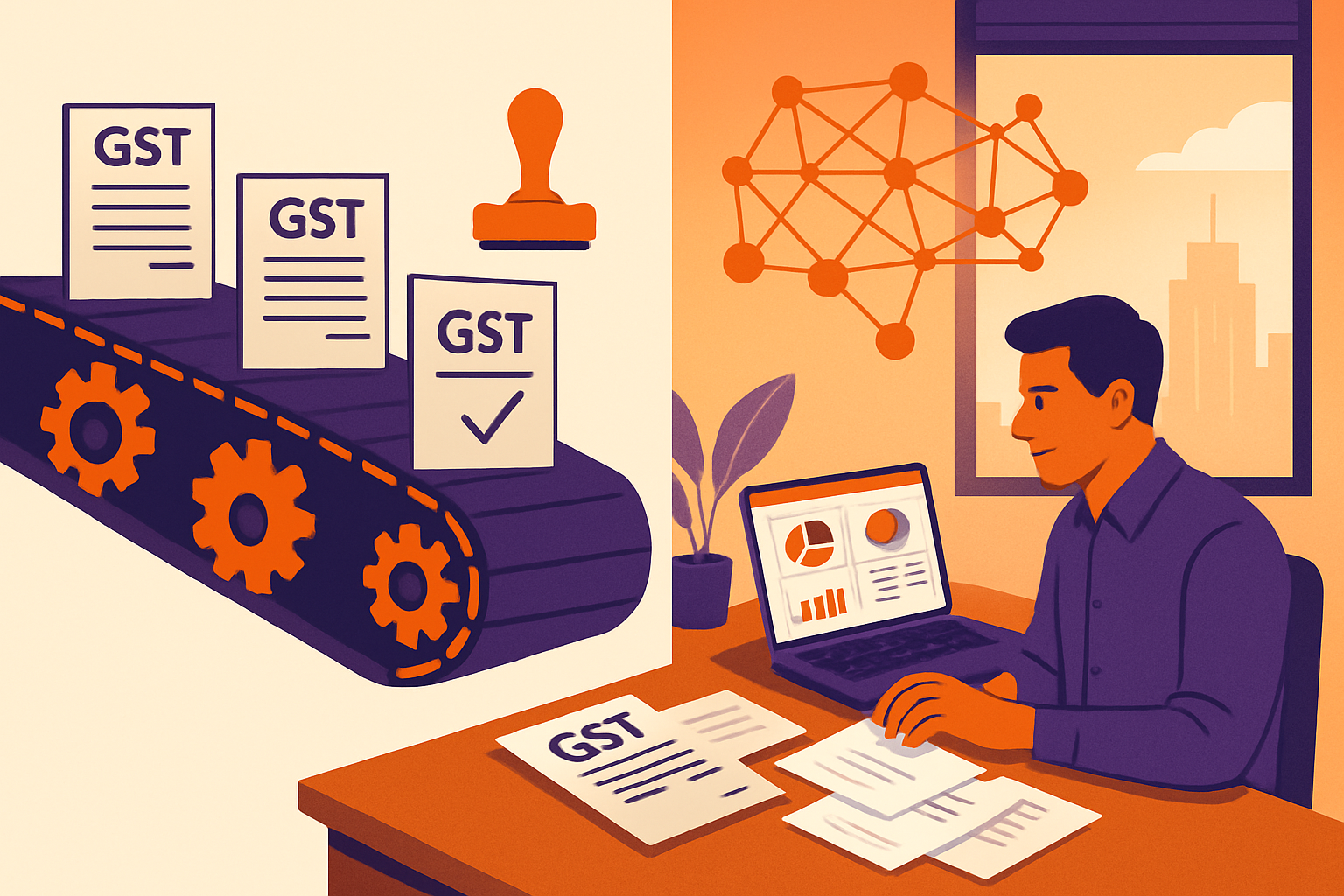
Don't let anyone talk you out of RPA for structured, repetitive, rule-based work. It remains the most cost-effective option for accounts payable, accounts receivable, payroll processing and bank reconciliation where the logic is stable and the inputs are structured (source).
This is also the territory we've covered before in Why Excel Alone Is No Longer Enough for Mid-Sized Indian Companies — the first automation upgrade most finance teams need isn't AI, it's simply getting off spreadsheets and into rule-based systems that don't break every time a formula gets overwritten. If you're still running month-end close on linked Excel workbooks, solve that before you even think about AI.
Where does AI genuinely outperform rule-based systems?
AI earns its keep where the problem is inherently probabilistic, not rule-based: fraud detection across thousands of transaction patterns, credit risk scoring using non-traditional data, demand and cash-flow forecasting under volatile input variables, and increasingly, GST/TDS anomaly detection where the "rule" itself has ambiguity or the data is unstructured.
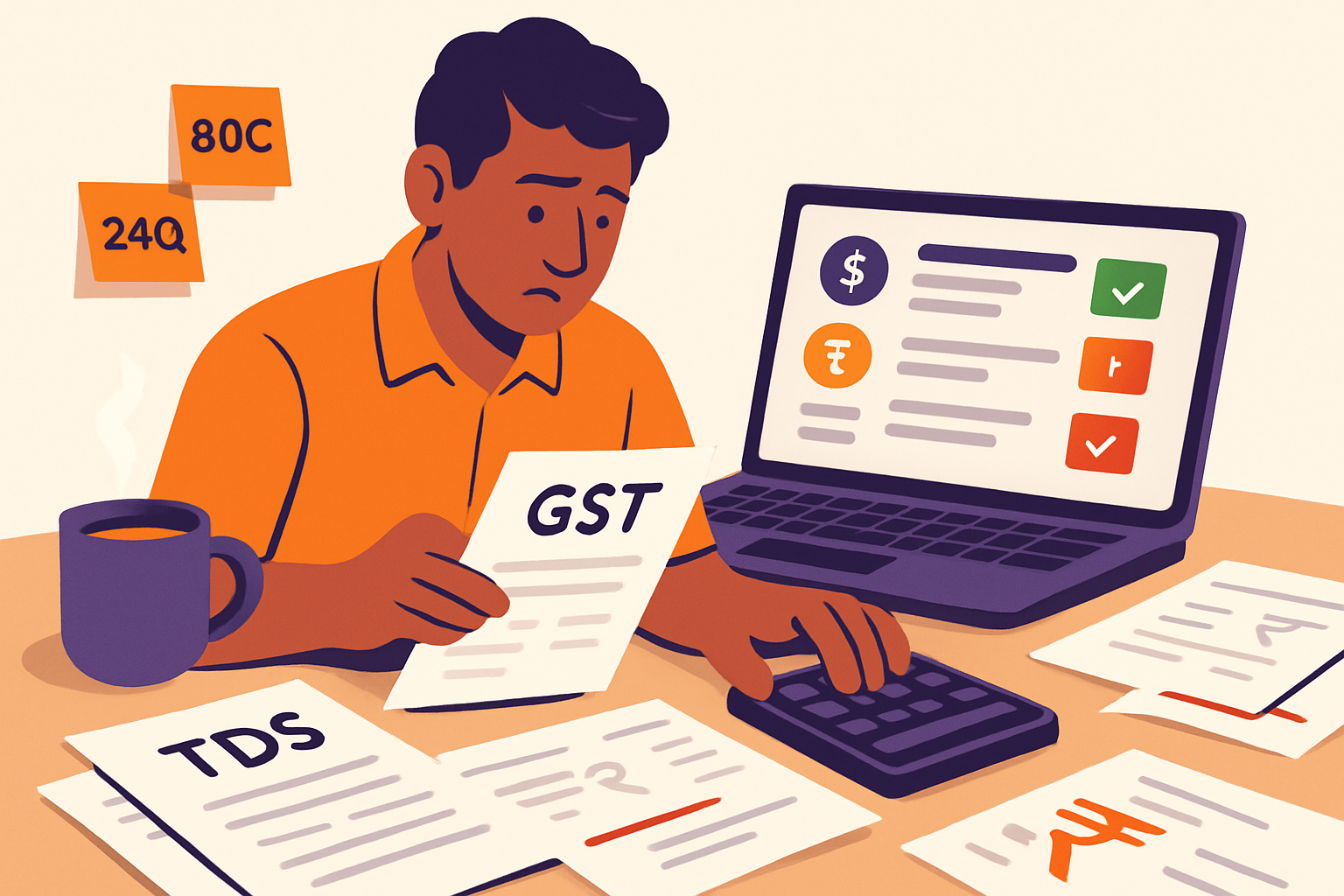
Consider TDS compliance. Manual TDS work in India is uniquely error-prone — dozens of sections (194C, 194J, 194Q, 194-O and counting), rates that shift by vendor category, cumulative threshold tracking across the financial year, and reconciliation between books, Form 26AS and TRACES that rarely lines up cleanly (source). A rule-based bot can apply a fixed rate table, but it can't catch the situation where a vendor crosses a cumulative ₹30 lakh threshold under Section 194Q mid-quarter because a purchase was split across three POs and two plants. An AI layer trained to reconcile across ledgers can flag that pattern before your auditor does.
GST reconciliation is the sharper example. Nearly 87% of Indian taxpayers report difficulty with GST reconciliation or filing (source), and the pain point is rarely the filing itself — it's reconciling GSTR-2B against purchase register entries scattered across ERP, vendor emails and courier-delivered physical invoices with mismatched invoice numbers or rounding differences.
Is a hybrid approach the honest answer for AI and automation in finance?
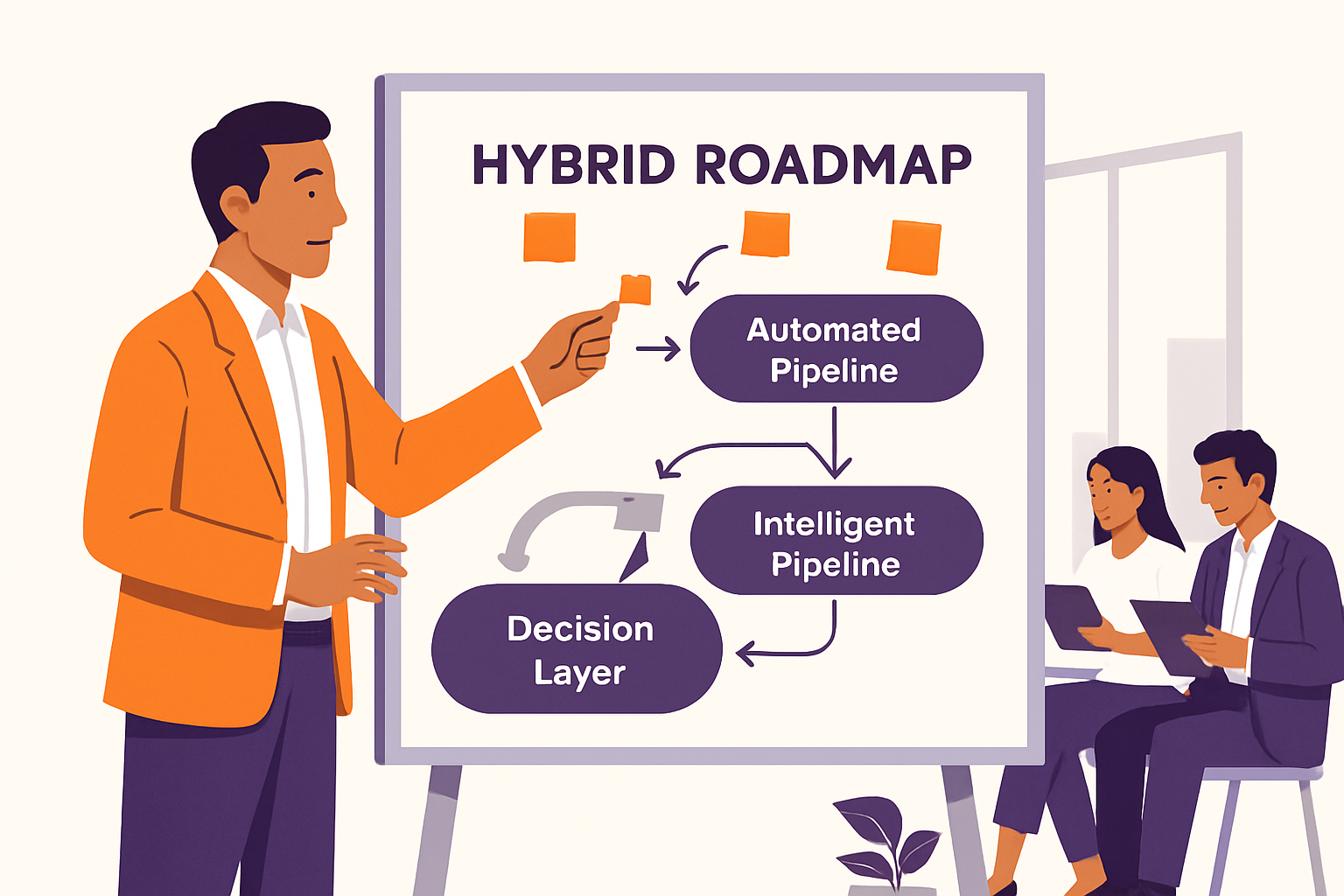
Hybrid is the honest answer, and increasingly it's the only answer that survives contact with a real mid-market IT budget. The emerging model here is "agentic automation" — combining generative AI's reasoning capability with RPA's execution reliability and existing workflow engines, so that AI can decide what needs to happen and RPA can execute it consistently across systems (source).
In practice, this looks like: RPA still does the mechanical extraction and posting (fast, cheap, deterministic), while an AI layer sits on top deciding which transactions need human review, forecasting cash positions from that clean structured data, and drafting exception reports in plain language for your controller. You don't rip out your existing Tally/SAP automation — you add a decision layer.
This matters because most mid-sized companies genuinely cannot afford a full AI-native rebuild, and shouldn't try. The pragmatic sequence is: fix data quality → automate the rule-based 70% → layer AI onto the remaining judgment-heavy 30%. Trying to reverse that sequence is exactly how companies end up in the complexity trap discussed below.
If your finance team is already thinking about visualizing this decision-layer output — where AI-flagged exceptions and forecasts actually surface for the CFO to act on — that's covered in more depth in P&L Dashboard Best Practices for Mid-Sized Indian Companies, which takes the reporting-and-visibility angle rather than the automation-architecture angle we're covering here.
Why does the "complexity tax" hit mid-sized Indian companies harder than large enterprises?
This is the part vendors don't lead with. Roughly 27% of the average mid-market AI budget in India is lost to complexity overhead — tool sprawl, integration failures, redundant licensing, and governance gaps — which nationally adds up to an estimated ₹33,000 crore in wasted AI spending annually (source). For instance, if a mid-sized company's AI budget is ₹80 lakh a year, that's roughly ₹21.6 lakh evaporating into integration consultants, duplicate SaaS subscriptions nobody remembers to cancel, and IT staff time spent stitching APIs together instead of solving business problems.
Large enterprises often have dedicated data engineering teams and resources to manage this complexity. Mid-sized companies, with more limited IT resources, find this significantly harder. Integrating AI with legacy ERP and outdated infrastructure remains a genuine, expensive obstacle requiring real investment in both systems and training (source), and the shortage of skilled AI talent compounds the problem — mid-sized firms often struggle with integration complexity, talent shortages and excessive configuration requirements that prevent pilots from ever scaling (source).
The practical rule: cap the number of standalone AI tools your finance function runs at any time. If you're piloting AI for GST reconciliation, don't simultaneously pilot a separate AI tool for forecasting and a third for vendor risk scoring unless they share a data layer. Sequential, not parallel, is how mid-sized teams avoid the tax.
Why is data quality the real bottleneck, not the AI model itself?
Every AI-in-finance pitch talks about the model. Almost none talk about the data feeding it, which is where the actual failure happens. 54% of Indian organizations cite poor data quality as their most pressing AI adoption challenge — higher than the broader APAC average of 50.4% (source).
For a mid-sized Indian company, this usually means: vendor master data with various spellings of the same supplier name, missing GSTIN fields, inconsistent cost center mapping, and bank statement formats that change every time the bank updates its portal. Feed an AI forecasting model this data and you'll get confidently wrong cash-flow projections — worse than no forecast at all, because leadership will act on false precision.
Before any AI pilot, run a data quality audit: sample 200 vendor records and 200 transaction lines, check for missing GSTIN, duplicate vendor codes, and inconsistent date formats. If your error rate exceeds 10%, fix the master data first. This single step prevents more failed AI pilots than any amount of model selection.
How should finance teams handle India's specific regulatory environment like GST, TDS, and MCA?
Regulators themselves are moving toward AI-assisted oversight, which changes the compliance calculus for finance teams. The MCA has introduced AI-enhanced systems to monitor corporate filings, detect anomalies and speed up processes like company name approvals, signaling a shift toward predictive, preventive regulation rather than after-the-fact penalty (source). Meanwhile Indian regulatory bodies, including the Reserve Bank of India (RBI), are actively promoting and developing frameworks for the responsible integration of AI in finance and digital compliance (source).
The practical implication: if the MCA's own systems are flagging anomalies in your ROC filings using AI, your internal compliance process should be at least as sophisticated at catching the same anomalies before you file — not after you receive a notice. Digital compliance adoption in India's fintech sector grew 38% between 2023 and 2025 (source) — that pace should worry any finance function still relying on quarterly manual GST/TDS reviews rather than continuous monitoring. This same continuous-monitoring logic is central to how AI is transforming internal controls more broadly, a topic we've explored in detail in AI for Internal Audit: Practical Use Cases for Mid-Sized Indian Companies — worth reading if your compliance risk extends beyond tax filings into broader control testing.
Why do ROI expectations for AI in finance so often disappoint?
This is where most CFOs get burned, and it's a timing problem, not a capability problem. 85% of Indian finance leaders report pressure to demonstrate AI ROI quickly (source), and many mid-market executives expect returns within eight months. Yet over half of Indian organizations report that AI deployments actually take six to twelve months just to reach go-live (source). That's an expectation gap of at least four to six months, and it's the single biggest reason boards kill promising AI initiatives prematurely — not because the technology failed, but because the timeline was set wrong at the start.
Set expectations before the pilot, not after: budget 8-10 months to production for anything beyond a narrow, single-workflow AI use case (e.g., invoice OCR or GST matching). Anything touching multiple systems — forecasting that pulls from ERP, CRM and bank feeds simultaneously — should be budgeted at 12+ months. Present this timeline to your board upfront, with interim milestones (data readiness at month 2, pilot accuracy benchmarks at month 5), so "no visible ROI yet" at month 4 doesn't get mistaken for failure.
Should AI replace human judgment in finance advisory and decision-making?
Not in India, and not soon. Indian investors and finance stakeholders show a strong, consistent preference for hybrid advisory models — combining human expertise with algorithmic efficiency — because they value personalization, emotional reassurance and clear accountability that a pure algorithm cannot provide (source). This applies just as much inside a finance function: when a controller flags a covenant breach risk to the CFO, or an FP&A analyst explains a variance to the board, the human framing of "here's what this means and what I recommend" carries weight that an AI-generated report alone doesn't.
The practical takeaway: use AI to generate the analysis, flag the anomaly, draft the first pass of the variance commentary — but keep a named human accountable for the final judgment call that goes to the board or the bank. This isn't a limitation of the technology; it's a design choice that builds trust faster and avoids the accountability vacuum that pure automation creates when something goes wrong.
What should a mid-sized Indian finance team actually do this quarter?
Skip the grand AI strategy document. Start narrower:
- Audit data quality first. Sample vendor master and transaction data for GSTIN completeness, duplicate records, and format consistency. Fix before automating.
- Consolidate rule-based automation. If AP, payroll or bank reconciliation are still manual or on Excel, close that gap with RPA before adding any AI layer — it's cheaper and faster to deploy.
- Pick one AI use case with clear ROI math. GST/TDS reconciliation is usually the best first bet given the volume of manual effort involved (source).
- Set a realistic timeline with your board. 8-12 months to production, not 8 months to ROI.
- Keep a named human accountable for every AI-assisted decision that leaves the finance function.
How BiPivot helps
BiPivot works with mid-sized Indian finance teams to sequence exactly this kind of decision — auditing data readiness, consolidating rule-based automation, and layering AI only where it earns its cost — instead of chasing every new tool that promises to replace everything. If you're weighing where to start, talk to BiPivot about mapping your own hybrid automation roadmap before your next AI budget cycle locks in.