

Finance Automation for FMCG: A CFO's Guide to Margins, GST and Distributor Chaos in India
By BiPivot Team · 2 September 2026
Every mid-sized FMCG finance head in India knows this pain intimately: you close the month, the numbers look fine, and then the GSTR-2B mismatch report lands, or a distributor disputes a scheme payout from four months ago, or your TDS liability under Section 194Q suddenly triggers a threshold you didn't track in real time. None of these are exotic problems. They are the ordinary Tuesday of an FMCG finance function running on spreadsheets, email chains, and a Tally or SAP instance that was configured for a business half your current size.
The Indian FMCG market was valued at USD 376.47 billion in 2025 and is projected to grow at a CAGR of 18.8% through 2034 (Maximize Market Research). That growth is exactly the problem. Volumes are compounding faster than most finance teams' capacity to reconcile them manually. This article is about what actually breaks in mid-sized FMCG finance operations, and what a properly designed automation stack fixes — with rupee numbers, not generic promises.
Why does GST compliance hurt FMCG finance teams more than most other sectors?
FMCG companies operate through dense, multi-state distribution networks — often five, ten, sometimes twenty GSTINs across depots, C&F agents, and regional offices. Every one of those GSTINs files its own GSTR-1 and GSTR-3B, against thousands of line-item invoices moving through primary and secondary sales channels every month.
Clear.in's practitioner research on FMCG finance teams flags exactly this: the complexity of GSTR-1 and 3B filing across multiple GSTINs, and the difficulty of reconciling GST returns against Input Tax Credit claims, as the two most persistent operational headaches (Clear.in). A finance team manually matching purchase register entries against GSTR-2B for even a mid-sized FMCG distributor network — say, 8 GSTINs and 40,000 monthly purchase invoices — is not doing high-value work. It is doing data entry with tax exposure attached.
Here's a worked example. Assume your company has ₹180 crore in annual purchases eligible for ITC, spread across 8 GSTINs. If manual reconciliation misses even 3% of invoices due to vendor GSTR-1 filing delays or invoice-level mismatches (a conservative real-world figure), that's ₹5.4 crore of ITC sitting in limbo every year — either blocked, reversed, or claimed incorrectly and later disputed in a GST notice. At an 18% average GST rate, that ₹5.4 crore purchase value translates to roughly ₹97 lakh of ITC at risk annually, purely from reconciliation gaps.
The upside is real too. Since e-invoicing came into force, real-time invoice generation has meaningfully improved the accuracy and authenticity of transaction reporting across FMCG supply chains, reducing errors that used to surface only at return-filing time (Times of India). GST has also let FMCG companies consolidate warehouses and cut transit times, since the old logic of a warehouse per state to avoid CST has disappeared (Wright Research). But the compliance layer on top of that consolidated, faster-moving supply chain has grown more granular, not less — e-way bills, e-invoice IRNs, and GSTR-2B auto-population all need to talk to each other in near-real time, and few mid-sized ERPs do this natively.
If your ITC reconciliation process still runs on a monthly spreadsheet pull, we've covered the mechanics of fixing this in detail in GST Reconciliation Using AI: A CFO's Guide to Faster ITC and Fewer Notices — worth reading alongside this piece if ITC leakage is your immediate fire.

Where does GST refund delay actually hit an FMCG P&L?
FMCG companies with export operations, inverted duty structures (common in packaged foods and personal care), or seasonal inventory buildup routinely have GST refunds stuck in process. The good news, per the same Times of India analysis, is that automated GST refund processing — with risk-based verification replacing blanket manual scrutiny — has genuinely sped up disbursement and reduced working capital blockage across FMCG (Times of India).
But that government-side improvement only pays off if your internal refund application data is clean. A mid-sized FMCG exporter we've seen in this space had ₹3.2 crore of accumulated ITC refund stuck for eleven months — not because the tax department was slow, but because the company's own shipping bill-to-invoice matching had errors that triggered repeated queries. Automating that matching at source, rather than firefighting queries after filing, is the difference between an 11-month refund cycle and a 60-day one. At a conservative 9% cost of working capital, that gap alone cost the company roughly ₹26 lakh in avoidable interest and opportunity cost over the year.
What does TDS automation actually solve in FMCG accounts payable?
FMCG vendor ecosystems are large and varied — raw material suppliers, packaging vendors, C&F agents, advertising and trade marketing agencies, freight contractors. Each vendor category sits under a different TDS section (194C, 194J, 194Q, 194H, and more), each with different rates and different cumulative thresholds that reset annually.
The real risk isn't the rate — it's misclassification and threshold tracking. A freight vendor incorrectly coded under 194C instead of 194Q once cumulative purchases cross ₹50 lakh in a year is a common, quietly expensive error. Automating TDS in accounts payable is specifically about eliminating misclassification, tracking cumulative thresholds in real time as invoices are booked, and automating Form 16A generation instead of a scramble each quarter (iQinvoice).
Consider an FMCG company processing 600 vendor invoices a month across 12 TDS sections. If even 2% of invoices are misclassified — a realistic manual error rate at that volume — and the average invoice value is ₹85,000, that's roughly 12 invoices a month with wrong TDS treatment. Compounded over a year, that's a mix of short deductions (which attract interest under Section 201, typically 1-1.5% per month) and excess deductions (which tie up vendor goodwill and trigger reconciliation disputes at the vendor's end). On a modest estimate, that's ₹4-6 lakh a year in interest and penalty exposure that a real-time threshold-tracking system would simply prevent by flagging the section change the moment cumulative payments cross the line.
We've written a full playbook on why this can't wait for the new tax law cycle in TDS Compliance Automation: Why Mid-Sized Indian CFOs Can't Wait for the New Income Tax Act 2026 — the FMCG-specific point to add here is that with 12+ vendor categories and constant vendor onboarding (new distributors, new trade marketing agencies every quarter), manual TDS classification simply cannot scale with the business.
Why do distributor disputes cost FMCG companies more than bad debt?
This is the pain point most finance-automation articles skip entirely, and it's the one most specific to Indian FMCG distribution. Your company doesn't sell directly to retailers — it sells through a layered network of super-stockists, distributors, and sub-distributors, each entitled to trade schemes, cash discounts, and volume-based margin slabs that change monthly.
A distributor claims a scheme payout of ₹1.8 lakh for a quarter based on their sales-out data. Your finance team, working off primary sales (sell-in) data from SAP or Tally, computes it differently — say ₹1.35 lakh — because secondary sales reconciliation (what the distributor actually sold to retailers) never fully synced with your system. The ₹45,000 gap sits in dispute for two billing cycles, the distributor withholds the next payment cycle in protest, and your DSO on that account balloons by 30-40 days. Multiply this across 150 distributors and even a modest 15% dispute rate creates a working capital drag that dwarfs your actual bad-debt provision.
This is precisely why distributors running on a proper Distribution Management System have a 74% five-year survival rate compared to 31% for those still on manual operations (SpireStock) — the difference isn't sales performance, it's that DMS-integrated finance data eliminates the scheme-calculation ambiguity that kills distributor relationships and cash flow simultaneously. For a mid-sized FMCG company, automating the sell-in to sell-out reconciliation — matching distributor claim data against your ERP's scheme masters automatically — is one of the highest-ROI finance automation projects available, and it's rarely the first thing anyone builds.
The same source notes that poor inventory and warehouse management, worsened by manual tracking, eats 2-4% of turnover in perishable FMCG categories through expired stock, damaged goods, and picking errors (SpireStock). On a company with ₹250 crore in perishable-category revenue, that's ₹5-10 crore a year — money lost not because product didn't sell, but because finance and warehouse data didn't talk to each other in time to prevent stock from expiring on shelf.
How much finance time is actually going to waste right now?
Across Indian SMB and mid-market finance functions, professionals spend a median of 39% of their time on manual, automatable tasks — the top quartile of companies has brought this down to 24% (Compass.ai). In accounts payable specifically, 66% of AP teams are still manually keying invoices into their ERP or accounting system (Dokka).
For an FMCG finance team of, say, 15 people with a fully loaded average cost of ₹9 lakh per person annually, that 39% manual-task figure represents roughly ₹52.6 lakh a year of finance capacity spent on invoice keying, reconciliation spreadsheets, and manual GST return prep rather than on demand-driven cash flow planning, distributor risk scoring, or margin analysis by SKU. Getting to the top-quartile 24% figure would free up roughly ₹20 lakh worth of finance capacity annually — capacity that, redeployed, typically pays for the automation investment within the first year.
Separately, quality and compliance teams in FMCG spend 20 to 35 hours a week on manual regulatory documentation alone (iFactory.ai) — a figure that compounds when you consider FSSAI, packaging regulations, and export documentation sitting alongside GST and TDS compliance, all competing for the same lean mid-market team's attention.
What's actually broken in the underlying finance systems?
Most of this isn't a people problem — it's an architecture problem. Legacy financial systems in FMCG companies typically run on fragmented data, manual reconciliation steps, and inflexible system architectures that were never designed for the transaction volume or the multi-entity complexity the business has grown into (SeerBit). A Tally instance configured five years ago for three GSTINs and 2,000 monthly invoices is being asked today to handle nine GSTINs and 18,000 invoices, with GST filing, TDS, and distributor scheme logic all bolted on as spreadsheet workarounds.
This is the same underlying issue we've explored from the manufacturing side in Finance Automation for Manufacturing Companies: A CFO's Guide to Margins, Compliance and Cash Flow — the FMCG variant is distinctive because the transaction volume is driven by distribution complexity and SKU proliferation rather than production BOM complexity, but the root cause (fragmented systems, manual bridges between them) is identical.
Digital transformation, done properly, has demonstrably improved financial resilience at leading Indian FMCG firms — measurably affecting net cash flow, profit margins, and inventory turnover according to peer-reviewed research on the sector (Emerald Insight). The gap for mid-sized players isn't that automation doesn't work — it's that until recently, the tools capable of this were priced and architected for enterprise FMCG majors, not for a ₹300-500 crore revenue company running Tally Prime and three regional warehouses.
Is AI-driven automation actually accessible to mid-sized FMCG companies now, or just enterprise hype?
This has genuinely changed in the last two years. AI-driven automation tools that were previously the preserve of large FMCG enterprises — demand forecasting engines, inventory optimization, pricing intelligence — are now accessible to mid-sized players at a fraction of the earlier cost, materially leveling the competitive field (Capably.ai). The same source notes AI-driven automation's core value for FMCG finance sits in improved demand forecasting, optimized inventory management, better manufacturing efficiency, and sharper pricing strategy — all of which have direct P&L and working-capital consequences.
Adoption reflects this shift: roughly 43% of FMCG companies in India have already adopted AI in some form, and nearly 75% of Indian businesses overall are actively considering AI integration (Stratefix). And the return expectations are not speculative — 93% of Indian organizations expect positive ROI on AI investment within three years, with an average realized ROI of 15% in 2025, projected to climb to 31% within two years (SAP News). India's broader digital transformation market — $46.42 billion in 2025, growing at 13.5% CAGR through 2030 (MarketsandMarkets) — is the tide that mid-market FMCG finance transformation is riding on.
At the enterprise-scale end of what's possible, EY's automated regulatory reporting tooling built on Snowflake demonstrates the ceiling: an 80% reduction in reporting effort, 40% faster turnaround, and 35% enhanced governance for financial institutions in India (EY India). Mid-sized FMCG companies won't need — or afford — that exact stack, but the principle transfers directly: purpose-built automation on top of clean transaction data compresses reporting effort by an order of magnitude, not a marginal percentage.
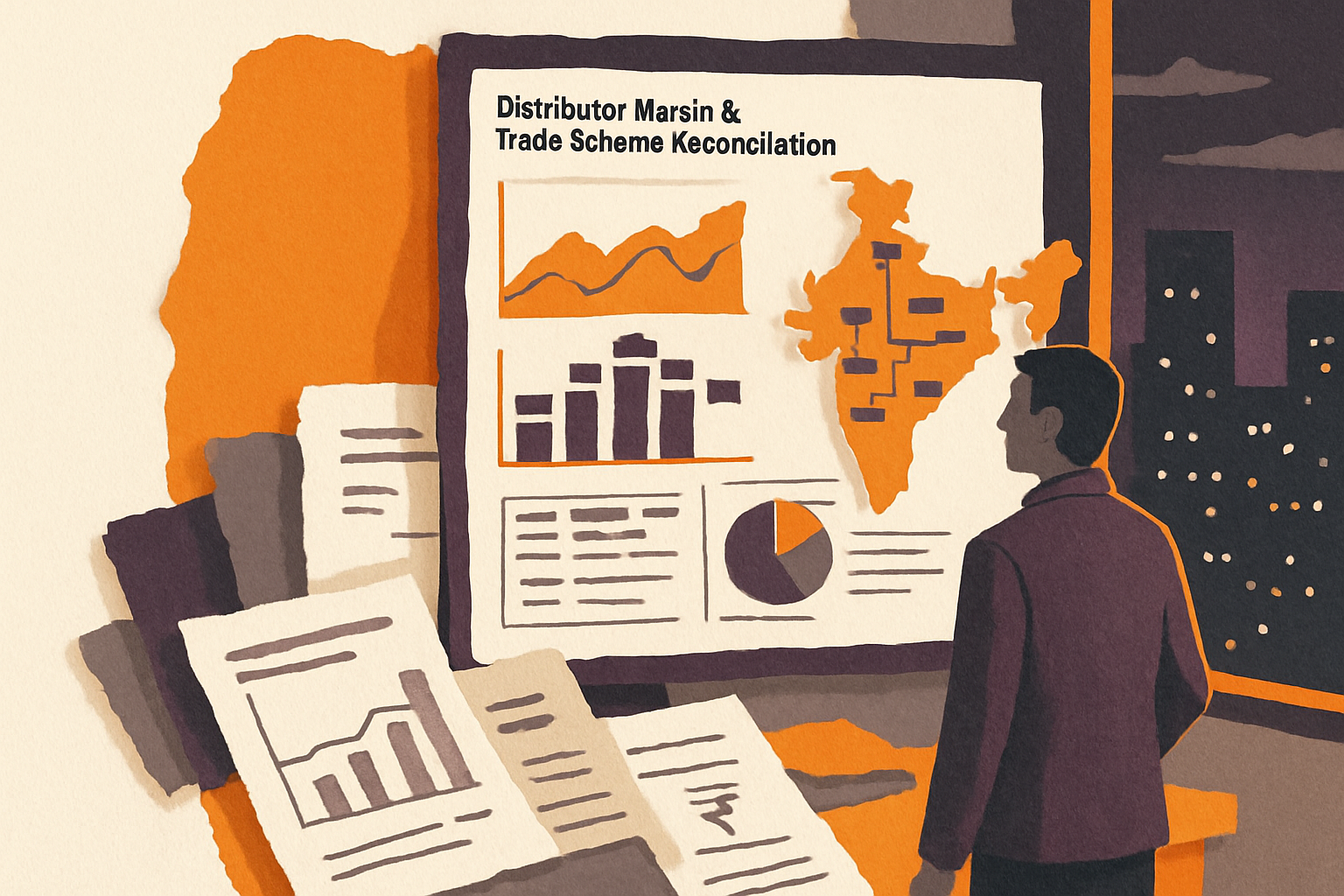
What should proactive intelligence look like instead of reactive compliance?
The shift worth making isn't automating the same reactive tasks faster — it's using the same data pipeline to get ahead of problems. Three concrete examples for FMCG finance teams:
-
Vendor risk scoring before GST filing season. Instead of discovering at return-filing time that a key raw material vendor hasn't filed their GSTR-1, an automated system flags non-compliant vendors in real time, letting you renegotiate payment terms or withhold payment before ITC is blocked — not after.
-
Distributor scheme forecasting. Rather than reconciling scheme payouts after the quarter closes, matching sell-in projections against historical sell-out patterns lets finance flag likely disputes before the claim is even raised, and pre-approve or query it within days instead of months.
-
Cash flow stress-testing against GST refund cycles. Given how much FMCG working capital sits tied up in ITC and refund cycles, automated cash flow models that incorporate expected refund timing (rather than treating refunds as a lump-sum surprise) give the CFO a genuinely forward-looking liquidity view instead of a monthly snapshot.
If your finance function is still built around monthly closing and quarterly review cycles, this is worth reading alongside Internal Financial Controls Explained: What Mid-Sized Indian Companies Actually Need to Build — the control framework and the automation layer need to be designed together, or you end up automating a broken process faster.
Where should a mid-sized FMCG CFO actually start?
Not with a full ERP overhaul. Sequence it:
- GST and ITC reconciliation first — this is where the fastest, most measurable cash impact sits, typically within one filing cycle of implementation.
- TDS threshold tracking in AP — a contained, high-ROI fix that prevents interest and penalty leakage without touching your core ERP.
- Distributor scheme and secondary sales reconciliation — the highest-effort but highest-payoff project, because it touches sales, finance, and distribution data simultaneously.
- Demand and inventory forecasting — once the transactional data is clean and automated, this is where AI genuinely starts improving margin, not just compliance.
Each of these can be implemented as a discrete project with its own payback period rather than a single monolithic transformation program — which matters enormously for a mid-sized company's budget cycle and risk appetite.
How BiPivot helps
BiPivot works with mid-sized Indian FMCG finance teams to sequence exactly this kind of automation roadmap — starting with GST and TDS reconciliation, then extending into distributor and inventory data once the foundation is clean. If you're trying to figure out where your finance function's manual-effort percentage actually sits and what to fix first, get in touch through BiPivot to talk through a practical, sequenced plan rather than a platform pitch.