

AI in Retail Finance: What Mid-Sized Indian CFOs Should Actually Do in 2026
By BiPivot Team · 1 September 2026
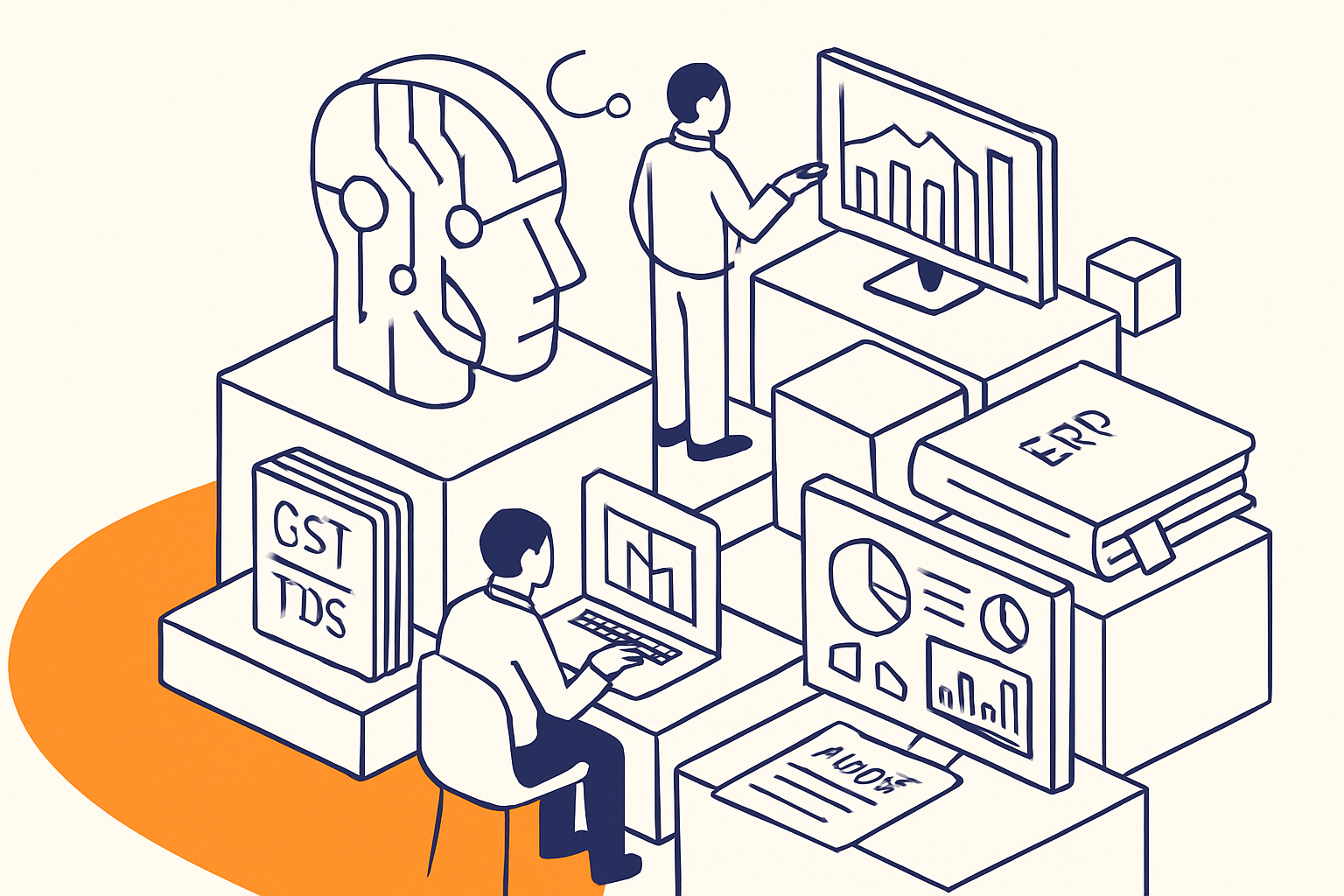
Walk into the finance function of any mid-sized Indian retail chain today and you'll hear the same sentence in some form: "We need to do something with AI." Boards are asking. Auditors are asking. Even the bank relationship manager is asking during the annual renewal meeting. What's missing, in most cases, is a clear-eyed answer to what AI actually does to a retailer's books, its GST filings, its TDS returns, and its month-end close — and what it costs to get there properly.
This isn't a market-sizing article. It's a working guide for the CFO or finance head of a Rs 150-500 crore retail business who has to decide, this quarter, where the next AI rupee goes.
Why is AI suddenly non-negotiable for retail finance in India?
The numbers explain the urgency. India's AI market grew from USD 2.97 billion in 2020 to USD 7.63 billion in 2024, and is projected to hit USD 131.31 billion by 2032 at a 42.2% annual growth rate, with financial services among the biggest contributors (et-edge). At the CFO level specifically, 92% of Indian CFOs plan to increase AI spend in finance and procurement this year (CFOTech).
Retail is a natural first mover because the data volume is brutal: hundreds of SKUs, dozens of store locations, thousands of vendor invoices a month, and a GST return cycle that doesn't forgive mismatches. A 40-store apparel retailer processing 3,000 vendor invoices monthly, at even 3 minutes of manual matching per invoice, burns 150 person-hours every month just on invoice-to-GRN-to-GSTR-2B reconciliation. Organisations already running AI in finance and procurement report accounts payable processing 80% faster and requisition processing 50% faster (CFOTech) — for that 40-store retailer, that's the difference between a 3-person AP team drowning every month-end and one that closes books by the 3rd working day.
The bigger shift, though, is in what finance is being asked to become. As AI takes over reconciliation and reporting mechanics, it pushes finance from backward-looking reporting toward real-time, predictive decision-making — continuous cash visibility, scenario planning for festive-season inventory bets, margin forecasting by category. AI is increasingly described as the "intelligence layer" of India's financial ecosystem, moving beyond automation into smarter decisioning across payments, lending, fraud detection and compliance (Outlook Business). For a retail CFO, that means the AI conversation isn't just "can we automate AP" — it's "can we predict a working capital crunch six weeks before Diwali stocking, instead of discovering it in the cash flow statement after."
Where does AI actually move the needle in a retail finance function?
Not everywhere equally. Based on what we see working in mid-sized Indian retail, four areas consistently deliver measurable returns within two to three quarters:
1. Invoice-to-GST reconciliation. This is the highest-volume, highest-error-rate task in retail finance, and it's where AI-driven tools automate invoice matching against GSTR-2B, flag mismatches, and apply tax evasion analytics to catch vendor-side errors before they cost you Input Tax Credit (Miles Education). We've written in detail about the mechanics of this in our guide to invoice matching automation and protecting ITC and in our piece on GST reconciliation using AI — worth reading before you shortlist a vendor, because the failure modes (partial credit notes, e-way bill mismatches, vendor GSTIN cancellations mid-quarter) are specific to how retail buys, not how manufacturing buys.
2. TDS and TCS monitoring. Retailers with marketplace sales, commission-based store partnerships, and high vendor payment volumes have TDS exposure across sections 194C, 194H, 194Q and TCS under 206C(1H). AI systems now automate TDS/TCS monitoring and reconcile declared figures against the Annual Information Statement in near real time, catching mismatches and omissions before the department does (EZTax). Given that the compliance goalposts keep moving, see our breakdown of TDS automation ahead of the new Income Tax Act for the specific sections retail finance teams get wrong most often.
3. Expense audit and accounts payable. Store-level expense claims — petty cash, local vendor payments, marketing spends by regional managers — are areas where AI-based anomaly detection on expense claims (duplicate bills, round-number claims, weekend transaction spikes) can enhance the automation of routine tasks like expense auditing.
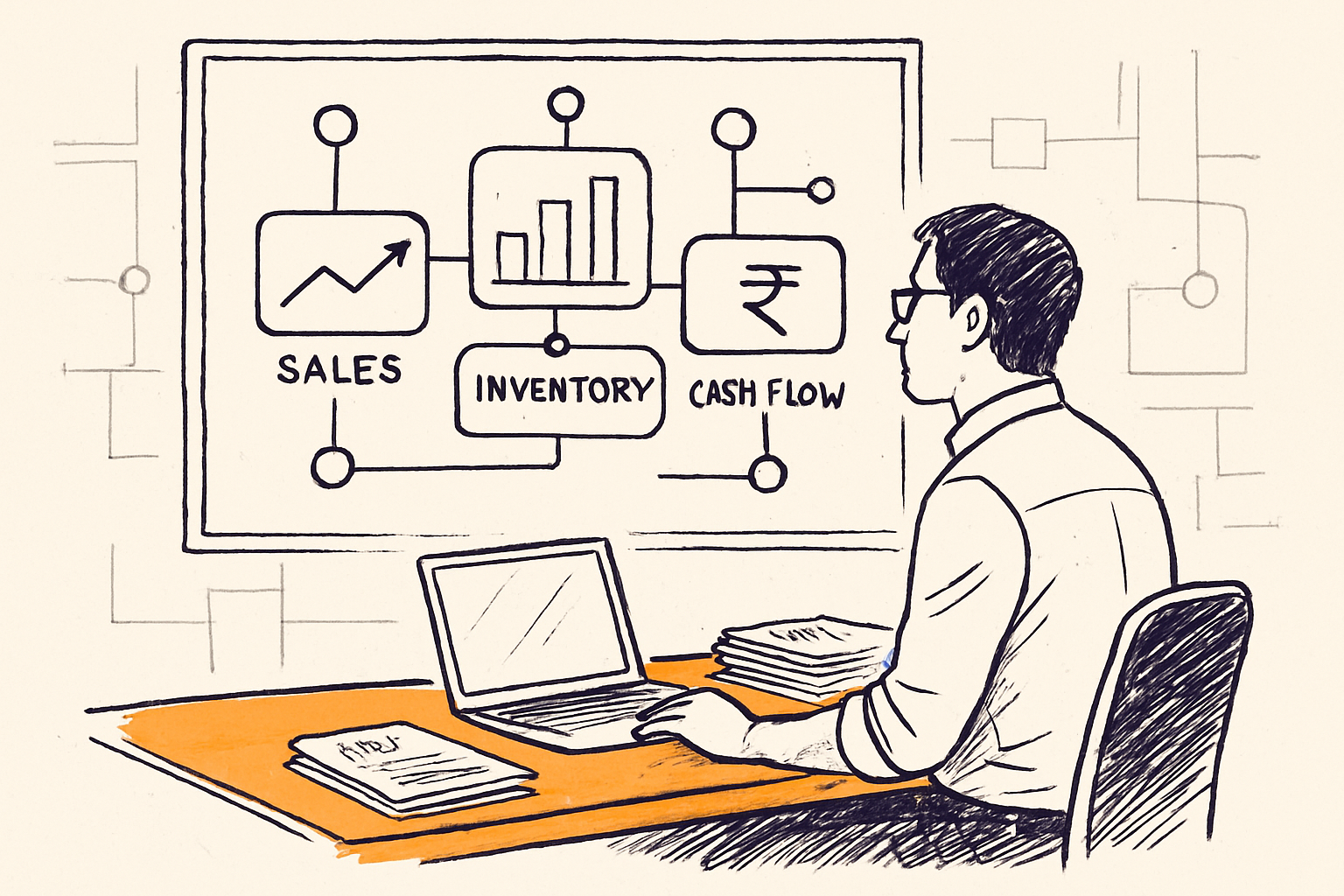
4. Cash flow forecasting at SKU and store-cluster level. This is the genuinely strategic use case: feeding POS data, vendor payment terms, and seasonal demand curves into a forecasting model that tells you, three weeks out, whether your working capital line will hold through the festive stocking cycle.
What does a worked ROI case actually look like?
Take a mid-sized grocery retail chain with 60 stores, Rs 280 crore annual turnover, and a finance team of 12 people handling AP, GST, and TDS across all locations.
Before AI: 4 AP executives spend roughly 22 working days a month matching 4,500 vendor invoices against POs and GRNs, with an average ITC leakage of Rs 18-22 lakh per quarter from missed or delayed invoice matches (vendor hasn't filed GSTR-1, mismatched GSTIN, wrong HSN code). Month-end close takes 9 working days.
After deploying an AI-based invoice matching and reconciliation layer (implementation cost roughly Rs 14-18 lakh for a 60-store setup, plus Rs 3-4 lakh annual licensing): AP processing time for the same 4,500 invoices drops to roughly 6 working days for 2 executives — consistent with the 80% faster AP processing benchmark reported industry-wide (CFOTech). ITC leakage falls to Rs 4-6 lakh per quarter because mismatches get flagged within 48 hours instead of surfacing at quarterly reconciliation. Month-end close compresses to 5 working days.
Net annual impact: roughly Rs 48-64 lakh in recovered ITC plus reallocation of 2 FTEs to higher-value analysis work, against an all-in first-year cost of about Rs 20-22 lakh. That's a payback period under six months — but only if the underlying vendor master data and HSN codes were clean to begin with, which brings us to the harder part of this story.
Why does GST and TDS compliance make Indian AI adoption different?
This is where generic AI-in-finance content, mostly written for US or European audiences, breaks down completely for an Indian retail CFO. Two structural facts change the calculus:
First, India has no standalone AI tax statute. AI and technology businesses — including the AI tools you deploy in your own finance stack — are governed through a patchwork of existing law: the Income Tax Act, the IGST Act, and the CGST Act (VLO Law). Practically, this means there's no bright-line rule for how an AI vendor's SaaS fee should be characterized for TDS purposes (royalty vs fees for technical services vs software license), and no separate compliance carve-out just because a decision was made by an algorithm rather than a person. If your AI tool auto-approves a vendor payment and misapplies TDS under section 194C instead of 194J, the liability sits with your company, not the software vendor. Build sign-off checkpoints accordingly — this is precisely the kind of control gap we cover in our guide to internal financial controls for mid-sized Indian companies.
Second, GST invoice matching and TDS-AIS reconciliation are moving targets because the regulatory rules themselves update frequently — HSN code mandates, e-invoicing thresholds, and reporting formats have all shifted in the past two years. AI tools that hard-code today's rules will misfire the next time thresholds change. Ask any vendor directly: how quickly does your rule engine update when CBIC issues a notification, and who is liable if your GSTR-3B gets filed against a stale rule set? If you haven't already systematised the underlying error patterns your team sees quarter after quarter, read our list of common GST errors AI can catch before they cost you ITC — it's a useful checklist to hand your IT and finance teams before they even start vendor evaluation.
What breaks when mid-sized companies try to scale AI in finance?
Three failure patterns show up again and again in retail finance AI rollouts, and none of them are about the AI model itself.
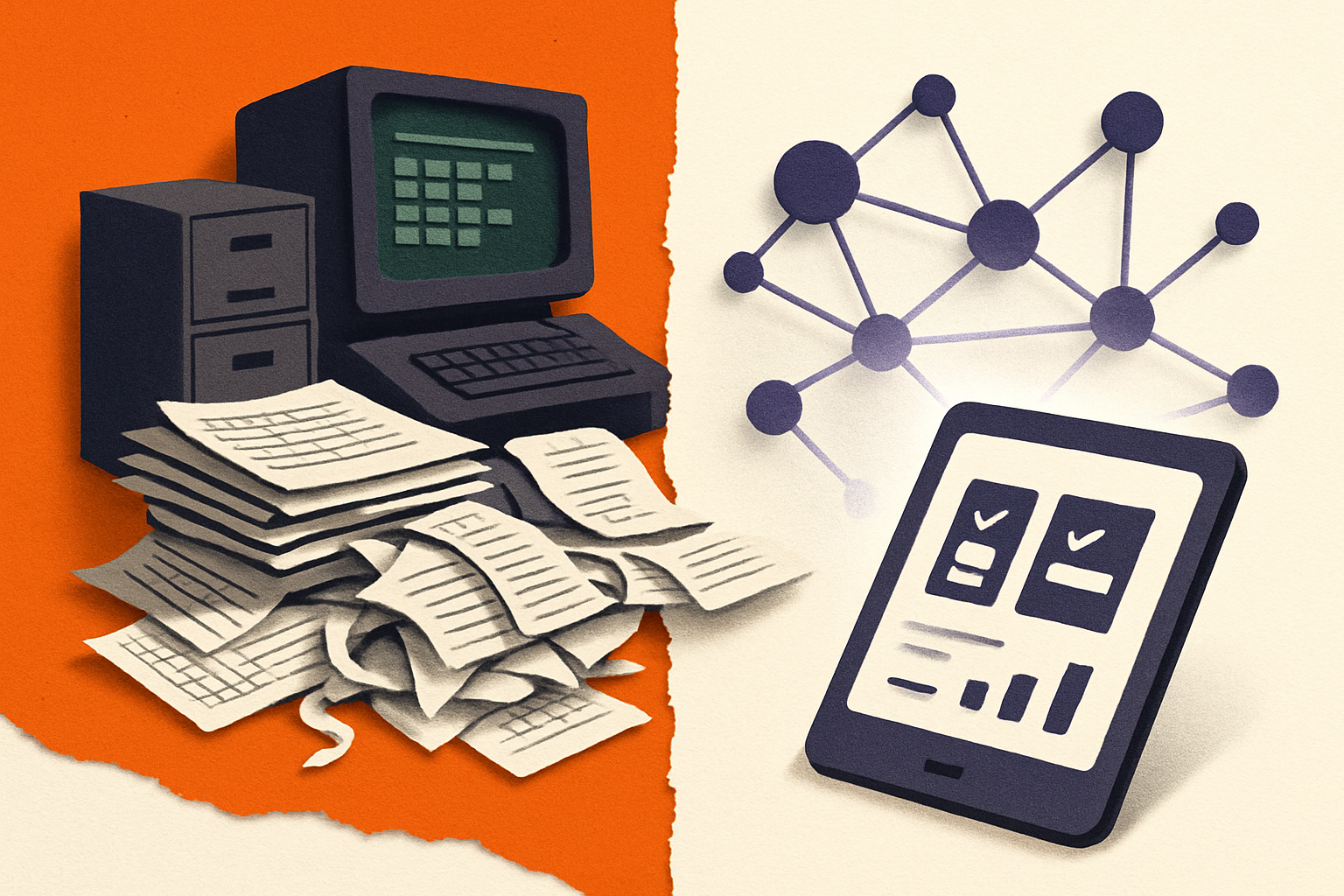
Data silos and legacy systems. Most mid-sized Indian retailers run a patchwork — Tally or an older SAP Business One instance at the accounting layer, a separate POS system per store format, a third system for vendor master data, and Excel bridging the gaps. Persistent data silos, legacy infrastructure, and gaps in governance frameworks remain the primary blocker to full-scale AI transformation in Indian financial firms (Maveric Systems). An AI reconciliation tool fed inconsistent vendor GSTINs across three systems will produce confidently wrong output — the "garbage in, garbage out" problem is more dangerous with AI than with manual processes, because manual teams catch obvious inconsistencies; automated pipelines often don't, until a GST notice arrives.
Skill shortages. Skill gaps, high deployment costs, cybersecurity exposure, and an inability to clearly define what AI is supposed to achieve are consistently cited as major constraints for Indian businesses implementing AI (TCS). A 12-person finance team that has never worked with a data scientist or ML engineer cannot be expected to independently validate whether an AI vendor's fraud-detection model is actually tuned to retail transaction patterns versus a generic banking dataset. Budget for training or a fractional AI-literate hire before you budget for the software license — the license is the easy 20% of the problem.
The ROI-governance trade-off. This is the sharpest tension in the data. 85% of Indian finance leaders report significant pressure to demonstrate ROI from AI investments (Business Standard). Under that pressure, 71% of Indian finance leaders prioritise quick AI agent deployment over governance, with only 8% prioritising governance first — and 27% admit that accountability for significant AI agent errors is unclear or rests with no one at all (Business Standard).
Translate that into a retail scenario: an AI agent auto-approves 200 vendor payments a week based on three-way matching. It approves a duplicate payment of Rs 3.2 lakh to a vendor because the invoice number formatting differed by one character and the model treated it as a new invoice. Who owns that error — the AP executive who set up the workflow, the IT team that deployed the tool, or the vendor who sold the AI model? In 27% of Indian finance functions today, per the data above, the honest answer is: nobody knows. That's not an acceptable answer to an internal auditor, and it's a worse answer to the board.
How should a CFO sequence AI adoption without breaking compliance?
Skip the "pilot everything at once" instinct. A sequenced approach that we've seen work across retail engagements looks like this:
-
Fix the master data first (Month 1-2). Clean vendor GSTIN records, HSN codes, and standardise invoice numbering conventions across all store/warehouse systems before any AI tool touches them. This is unglamorous and it's 60% of the eventual success rate.
-
Start with a single, high-volume, low-ambiguity process (Month 2-4). Invoice-to-GSTR-2B matching is the best starting point for most retailers because the rules, while evolving, are objectively verifiable — an invoice either matches the portal data or it doesn't. Don't start with fraud detection or forecasting; those require judgment calls that are harder to govern early.
-
Write the SOP before you write the automation rule (Month 3). Every AI workflow needs a documented escalation path: what happens when the model flags a mismatch, who reviews it, what's the SLA. If your SOPs currently live in people's heads or in a folder nobody opens, fix that first — our guide to building SOPs employees actually follow is directly applicable here, because an AI tool without an enforced human-review SOP behind it is just automation without accountability.
-
Build the governance layer in parallel, not after (Month 3 onward). Assign a named owner for AI-related errors before go-live — not a committee, one person with authority to halt an automated workflow. This directly addresses the 27% accountability gap cited above. For a fuller framework on board-level AI oversight, see our governance playbook for mid-sized Indian companies.
-
Measure ROI on a 90-day rolling basis, not a single business case. Track hours saved, ITC recovered, and error rates monthly. A tool that looked good in the sales pitch but shows declining match accuracy by month 4 (often because it wasn't updated for a GST notification) needs to be caught early, not discovered at year-end audit.
-
Expand to forecasting and predictive use cases only after the compliance layer is stable (Month 6+). Cash flow prediction and demand forecasting are valuable, but they're judgment-augmenting tools, not compliance-critical — sequence them after the higher-stakes GST/TDS automation is proven.
If your finance function already runs as (or is moving toward) a shared services model across multiple store clusters or business units, AI adoption sequencing changes slightly — centralise the AI governance and data-cleaning function at the shared services layer rather than replicating it per store cluster. Our playbook on building a finance shared services centre covers the structural decisions that make this kind of centralisation work.
What should be in an AI vendor contract for retail finance?
Before signing anything, get these five items in writing, not just in the sales deck:
- Regulatory update SLA: how fast does the tool's rule engine reflect new CBIC/CBDT notifications, and is that update included in the license fee or billed separately?
- Error liability clause: who bears the cost if the tool's misclassification causes a TDS short-deduction penalty or ITC reversal — explicitly, in the contract, not left to "reasonable efforts" language.
- Data residency and access: where is your vendor master data and transaction data stored, and can you export it fully if you switch vendors in 18 months?
- Audit trail requirement: can every AI-flagged or AI-approved transaction be traced back to the specific rule and data point that triggered the decision? Your statutory auditor will ask for this at year-end.
- Human override logging: every time a finance team member overrides an AI recommendation, that override should be logged with a reason code — this becomes your internal control evidence and your defense if a regulator later questions a decision.
What's the real timeline for a mid-sized retailer to see returns?
Realistically: 3-4 months to clean data and deploy the first automation layer (invoice matching), 6-9 months to see the ITC recovery and AP efficiency gains stabilise into your P&L, and 12-18 months before forecasting and predictive use cases mature enough to influence actual working capital decisions. Any vendor promising full transformation in 60 days is either underestimating your data mess or overselling the model.
The CFOs who get genuine value from AI in the next 18 months won't be the ones who deployed the most tools fastest. They'll be the ones who fixed their master data, wrote enforceable SOPs, named an accountable owner for AI errors, and treated GST/TDS compliance as the non-negotiable floor — not an afterthought bolted onto a shiny forecasting dashboard.
How BiPivot helps
BiPivot works with finance teams at mid-sized Indian retailers to sequence AI adoption around what actually matters first — clean master data, GST/TDS-compliant automation, and governance that survives an audit. If you're deciding where your next AI rupee should go, explore our approach at bipivot.com or look at our consulting and tools pages for what a working engagement looks like in practice.