

Microsoft Copilot vs ChatGPT: Which One Should Run Your Finance Team in 2026?
By BiPivot Team · 10 September 2026
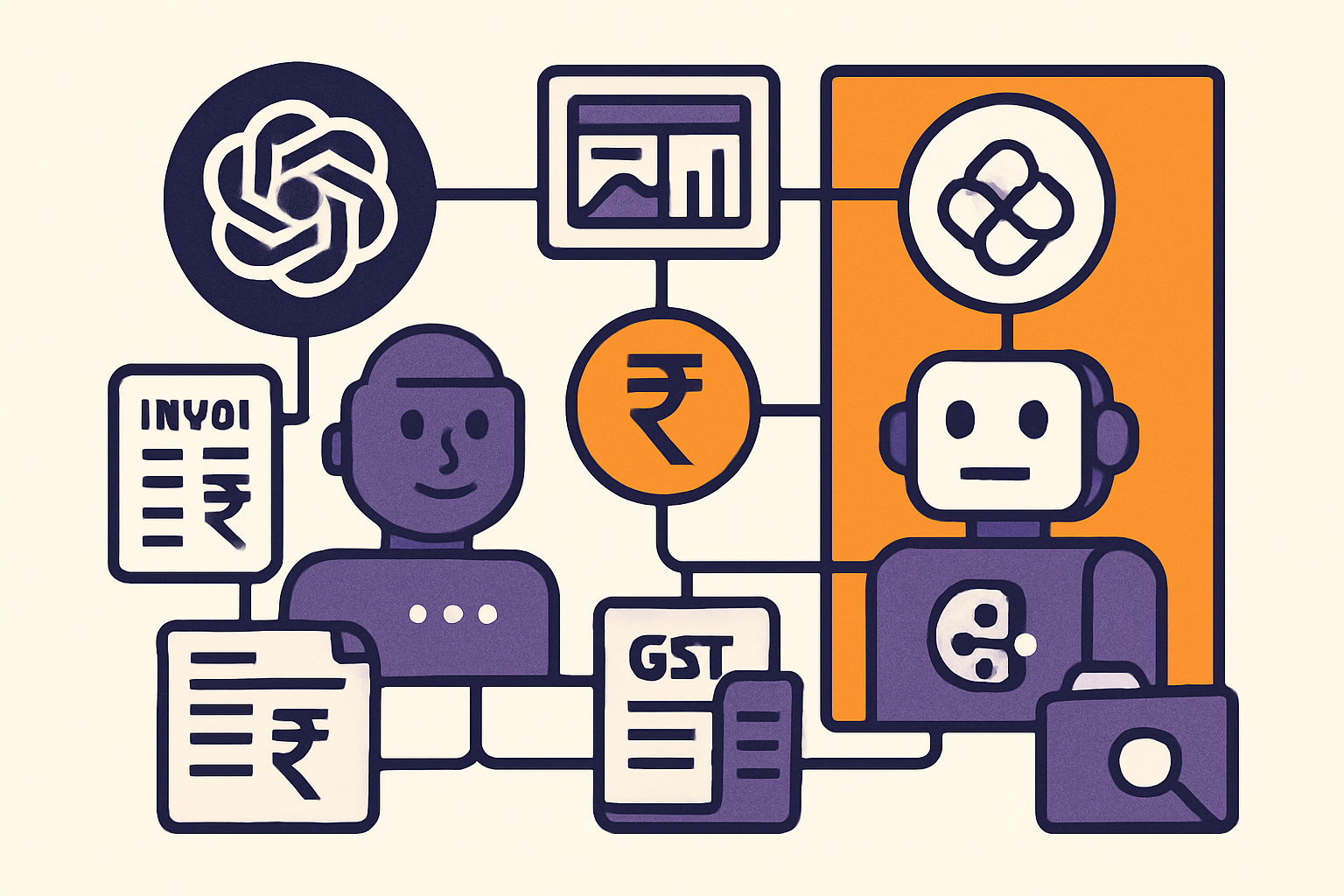
Every CFO I've sat with in the last six months asks some version of the same question: "We already pay for Microsoft 365 — do we also need ChatGPT?" The honest answer is that it depends less on which model is smarter and more on where your finance team actually loses hours every month, and how exposed you are on data governance once you plug either tool into GSTR-2B reconciliations or vendor ledgers.
This isn't a feature shootout. It's a decision framework for finance heads at mid-sized Indian companies — the ₹200 crore to ₹2,000 crore revenue band — who need a defensible answer when the audit committee asks "who approved this AI subscription, and what data does it touch?"
What Actually Separates Copilot From ChatGPT for a Finance Team?
Microsoft Copilot lives inside the tools your team already opens forty times a day — Excel, Outlook, Teams, Word. It reads from your organisational data under your existing IT governance, which means a controller in Chennai using Copilot for a bank reconciliation isn't creating a new data exposure point; it's operating inside the same tenant, same access controls, same audit trail Microsoft already manages for you (source). For finance specifically, Copilot for Finance pulls from Dynamics 365 or SAP to automate data reconciliation, run variance analysis directly in Excel, and even manage collections follow-ups from within Outlook (source).
ChatGPT plays a different game. It's a standalone conversational tool, and its real strength shows up when you upload a messy P&L export, a distributor claim file, or a board deck draft and ask it to reason across all of it — open-ended analysis, drafting from a blank page, scenario modeling that doesn't fit neatly into a spreadsheet template (source). Finance teams use it for cash flow forecasting, market trend research, expense pattern analysis, and — increasingly — "vibe coding" small automation scripts to stitch together reports that would otherwise need a developer ticket (source).
If your biggest time sink is monthly close inside Excel, Copilot's home-turf advantage is real. If your biggest time sink is drafting board narratives, stress-testing a working capital scenario, or researching a competitor's pricing move, ChatGPT's flexibility wins. Most finance functions need both jobs done — which is why the real decision isn't "either/or," it's "which one first, and for which workflow."

Does Licence Count Even Matter If Nobody Uses It?
Here's a number that should worry every CFO who's already signed a Copilot enterprise agreement: workplace adoption for Microsoft 365 Copilot sits at just 35.8% among employees who actually have access, compared to an 83.1% workplace conversion rate for ChatGPT (source). Copilot has scale — over 20 million paid seats and use by more than 90% of Fortune 500 companies, with an average reported productivity gain of 14 minutes per user per day (source) — but scale of licensing is not scale of usage.
Meanwhile ChatGPT has crossed 9 million paying business users across more than 1 million business customers as of February 2026, and holds 62.5% of B2C subscription market share among AI tools as of June 2025 (source). People open ChatGPT because it's frictionless — no seat provisioning, no training deck, just a chat box.
For a mid-sized Indian company, this gap highlights a budgeting concern. The lower active usage rate for Copilot compared to its licensing figures means that simply purchasing licenses doesn't guarantee value. CFOs must assess true ROI based on actual utility, not just availability, to avoid paying for dormant seats. ChatGPT Plus or Team tiers, priced lower per seat, often get used by more of the people who bought them simply because there's no workflow change required to start.
The fix isn't choosing ChatGPT by default — it's refusing to buy licences without a 90-day adoption plan attached. Before rolling out Copilot to your full finance team, pilot it with the 8-10 people who do month-end close and reporting, track actual prompt usage through the Microsoft 365 admin center, and only scale the licence count once you see weekly active use above 60%. If you're already wrestling with dashboards that nobody looks at, the discipline is the same one we've written about in Common Dashboard Mistakes That Are Quietly Costing Indian CFOs Money — a tool nobody opens is a cost centre, not a capability, no matter how good the feature list looks.
How Do DPDP, RBI, and TDS/GST Actually Change This Decision?
This is the section most global comparisons skip entirely, and it's the one that should decide your vendor selection in India.
DPDP Act 2023. India's Digital Personal Data Protection Act requires "free, specific, informed, unconditional and unambiguous" consent for processing personal data, with full enforcement expected by May 2027 (source). If your finance team is uploading employee salary sheets, vendor bank account details, or customer credit data into any AI tool, you now need a documented consent and purpose-limitation trail. This is where Copilot's advantage is structural: it operates inside your existing tenant's data governance, so the same access controls, data loss prevention policies, and retention rules that already apply to your Excel files apply to Copilot's outputs. With ChatGPT, unless you're on an enterprise agreement with a signed data processing addendum, you're relying on employees to self-police what they paste into a chat window — a genuine risk when someone drops a full debtors ageing report into a prompt to "summarise the top 10 overdue accounts."
RBI's Free-AI framework. In August 2025, the RBI released its Free-AI Committee Report, proposing a lifecycle approach to AI governance for the financial sector — covering model explainability, responsible use, and data privacy obligations across the AI's entire deployment lifecycle, not just at rollout (source). If you're a mid-sized NBFC, a lending arm, or a company with treasury operations feeding into regulated reporting, this framework will increasingly shape what "acceptable AI use" looks like even outside pure banks. Build your AI usage policy assuming RBI-style scrutiny is coming to your sector within 18-24 months, not after it's mandated.
TDS and Section 194J/195. Indian tax treatment of AI subscription payments is genuinely unsettled. Where the AI service involves human-in-the-loop professional support (say, a Microsoft account manager configuring Copilot for Finance against your Dynamics 365 instance), TDS at 10% under Section 194J may apply as fees for technical/professional services. Where the service is purely automated software-as-a-service with no human involvement, some practitioners argue for the lower 2% technical services rate — but this remains contested under the Section 28 vs Section 56 debate on how AI-linked income should be characterised (source). Don't let your accounts payable team default to one treatment without a written position from your tax advisor — get it in writing before your first invoice from OpenAI or Microsoft's overseas billing entity lands.
GST via Reverse Charge Mechanism. If you're paying a foreign entity for AI subscriptions (OpenAI's billing entity, for instance) and that entity isn't registered in India for Online Information and Database Access or Retrieval (OIDAR) services, GST liability can shift to you under the Reverse Charge Mechanism (source). Concretely: if your finance team subscribes to a foreign AI service like ChatGPT Team and the foreign entity is not registered for OIDAR services against your billing address, your company may be liable to self-invoice and deposit GST under the Reverse Charge Mechanism. This often overlooked detail means an additional tax liability that many finance teams might not account for, as the invoice appears to be a routine SaaS subscription. Microsoft's Copilot billing, run through your existing Microsoft India entity relationship in most enterprise agreements, typically avoids this RCM complication because GST is already charged forward on the invoice.

Which Tool Fits a Mid-Sized Company's Real Infrastructure?
Large enterprises get white-glove rollouts. Mid-sized Indian companies get neither the budget nor the in-house AI talent for that – a constraint that shapes which tool will actually get adopted versus which one just sits on an invoice.
If you're not a pure Microsoft shop — say your ERP is Tally or a regional SAP B1 implementation, your CRM is something else entirely, and only your email runs on Microsoft 365 — Copilot's integration advantage shrinks fast. You'll get Copilot inside Outlook and Word, but the promised "pull data from ERP and auto-reconcile" experience needs Dynamics 365 or a properly licensed SAP connector, which is a separate implementation project with its own timeline and cost. For many mid-sized firms, that project competes for the same IT budget and attention as your core ERP reporting improvements — the kind we've detailed in Best Practices for ERP Reporting: A CFO's Playbook for Mid-Sized Indian Companies. Don't greenlight a Copilot-for-Finance rollout until your ERP reporting foundation is solid; layering AI on top of broken master data just automates the wrong numbers faster.
ChatGPT sidesteps this infrastructure dependency almost entirely. A controller can export a CSV from Tally, upload it to ChatGPT, and get a variance summary within minutes — no integration project required. That's exactly why 70% of Indian banks have moved AI from experimentation into selective production, even while scaling remains hard because of insufficient training data (61%), privacy and consent issues (53%), and data silos (46%) (source). The same pattern shows up in mid-sized companies: quick wins with ChatGPT for one-off analysis, followed by a much harder slog to get any AI tool to work reliably across siloed systems.
This is also where sector context matters. A pharma company juggling batch-level costing, regulatory reporting, and distributor claims has very different data-structuring needs than an FMCG business managing distributor margins and GST across hundreds of SKUs — we cover those specifics in Dashboard Requirements for Pharma Companies: A CFO's Blueprint for Mid-Sized Indian Firms and Finance Automation for FMCG: A CFO's Guide to Margins, GST and Distributor Chaos in India. Neither Copilot nor ChatGPT fixes a data silo problem by itself — they just make the consequences of bad data move faster.
Copilot, ChatGPT — Does It Even Matter Which "Other" Tool You Pick?
The honest answer is that the conversational-AI category (ChatGPT) competes on reasoning quality and pricing, while Copilot competes on a completely different axis — embedded workflow versus standalone assistant. The real fork in the road for a CFO isn't "ChatGPT vs Copilot" as interchangeable options; it's "do I need an embedded assistant inside my existing tools, or a standalone reasoning engine I bring data to." Once you've answered that, the specific vendor choice within each category becomes a secondary negotiation on price and data terms.
Practically, many finance heads I work with end up running both — Copilot for the Excel-heavy, ERP-adjacent reconciliation and reporting work, and ChatGPT for the analytical, narrative, and research work that doesn't live inside a spreadsheet. The mistake is assuming you need to standardise on one tool company-wide before you've measured where your team's actual bottlenecks are.
What Does the ROI Conversation Actually Look Like?
Indian finance leaders are optimistic on paper: 79% of CFOs and treasurers believe generative AI will be instrumental in modernising treasury operations and mitigating risk (source), and 94% believe it will meaningfully improve tax function effectiveness — up sharply from just 19% in 2023 (source). The broader India AI-in-finance market reflects that confidence, projected to grow from USD 867 million in 2023 to USD 9,651 million by 2032 at a 30.7% CAGR (source), and AI adoption across Indian sectors already sits at roughly 48%, with BFSI leading at 68% (source).
But optimism and pressure aren't the same as proof. Nationally, 92% of finance leaders feel pressure to demonstrate ROI from AI agents quickly, and only 7% say governance is being prioritised over speed (source). That imbalance is exactly how companies end up with unreviewed AI-generated numbers in a board deck, or an AI-drafted vendor communication that nobody checked against the actual contract terms.
Set your own ROI bar before you buy: define the specific hours-per-month task you expect the tool to compress, measure baseline hours honestly, and revisit the number at 90 days. If you can't name the task, you're buying a licence, not a capability.

So Which One Should You Actually Buy First?
Buy Copilot first if: you're already deep in the Microsoft 365 ecosystem, your ERP is Dynamics 365 or SAP with an existing connector, your biggest pain is repetitive Excel reconciliation and reporting work, and you have someone who can own a genuine adoption programme rather than just flipping on licences.
Buy ChatGPT first if: your infrastructure is heterogeneous or Tally-based, your finance team's biggest pain is analytical narrative work — board decks, scenario models, market research — and you need something your team will start using in week one with zero integration lift.
Whichever you choose, put a written AI usage policy in place before rollout — covering what data categories can and cannot be pasted into either tool, who signs off on AI-drafted numbers before they reach the board, and who owns the DPDP consent trail and the GST/TDS treatment of the subscription invoice. That policy costs you a week of a compliance officer's time. The alternative — finding out during a statutory audit that your finance team has been feeding customer PII into an unreviewed AI tool — costs a great deal more.
How BiPivot Helps
We help mid-sized Indian finance teams cut through the licence-versus-usage confusion — auditing where Copilot or ChatGPT would actually save hours in your specific ERP and reporting stack, and building the DPDP/GST/TDS-compliant usage policy before, not after, rollout. If you want a practical assessment rather than a vendor pitch, explore our work at BiPivot.